China Green Data Center Market – Size, Share, Trends, Growth Forecast, and Competitive Analysis (2025–2030)
Report Summary
The China Green Data Center Market is segmented by Component (Solutions, Services), by Type (Hyperscale, Colocation, Enterprise, Edge), by Tier (Tier I, Tier II, Tier III, Tier IV), by Data Center Size (Small <5 MW, Medium 5–20 MW, Large 20–100 MW, Mega/Hyperscale >100 MW), by Energy Source (Solar, Wind, Hydroelectric, Nuclear, Hybrid Renewable, On-site Generation vs Grid Renewable PPAs), by Deployment Model (Greenfield, Brownfield Retrofit/Modernization, Prefabricated Modular, Containerized), by End User (IT & Telecommunications, BFSI, Government & Public Sector, Healthcare, Retail & E-Commerce, Manufacturing & Automotive, Energy & Utilities, Media & Entertainment, Other Industries), and by Geography (China).
Report Overview:
The China Green Data Center market is undergoing strong, structurally driven expansion, supported by large-scale digital infrastructure build-out, accelerating cloud and AI workloads, rising energy-efficiency requirements, and tightening sustainability and regulatory mandates.
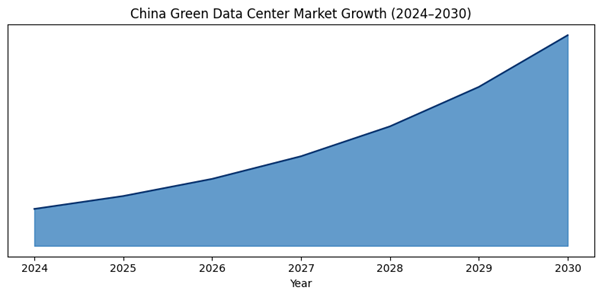
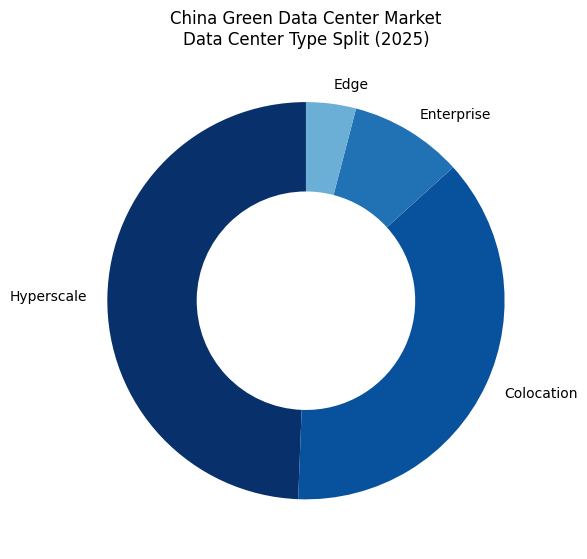
In 2024, the China green data center market is valued at USD 4.68 billion and is projected to grow to USD 23.20 billion by 2030, registering a CAGR of ~30.8% over the forecast period. Growth is not evenly distributed, but instead concentrated in hyperscale and colocation data centers, which together account for the majority of incremental capacity additions.
Market expansion is further reinforced by:
A decisive shift toward Tier III and Tier IV facilities
Consolidation into large and mega-scale campuses
Rapid adoption of solar, wind, hybrid renewables, and emerging nuclear power
Preference for greenfield and prefabricated modular deployment models
Strong demand from IT & telecommunications, BFSI, healthcare, retail & e-commerce, media, manufacturing, and energy & utilities positions green data centers as a core pillar of China’s digital economy and long-term sustainability strategy, rather than a niche ESG-driven investment theme.manufacturing, and energy & utilities sectors, coupled with a growing emphasis on ESG compliance and energy optimization, positions green data centers as a core pillar of China’s digital economy and long-term sustainability strategy.
Drivers :
● Hyperscale-led digital infrastructure expansion as the primary growth engine
China’s green data center growth is fundamentally anchored in hyperscale expansion, with hyperscale facilities growing at ~34.1% CAGR, materially faster than enterprise data centers (~23.1% CAGR). This divergence reflects sustained expansion of cloud platforms, AI training clusters, and large-scale digital services that require high-density, energy-efficient, renewable-integrated infrastructure as a baseline economic requirement rather than an optional sustainability feature.
● Accelerated migration toward high-tier, mission-critical facilities
A pronounced shift toward Tier III and Tier IV data centers is reshaping China’s capacity mix. Tier IV facilities grow at ~35.5% CAGR, significantly outpacing Tier I and Tier II facilities. This migration is driven by uptime requirements, regulatory expectations, and hyperscaler SLAs, directly increasing adoption of advanced cooling, power redundancy, and green energy systems.
● Energy mix transformation aligned with renewable scalability
China’s green data center growth closely mirrors the scaling of solar (~33.0% CAGR), wind (~30.8%), hybrid renewable systems (~30.5%), and nuclear (~42.1%) energy integration. These growth rates exceed or closely track the overall market CAGR, indicating that renewable adoption is structural, supporting long-term power cost stability and large-scale capacity expansion.
● Consolidation into large and mega-scale campuses
Capacity additions are increasingly concentrated in large (20–100 MW) and mega/hyperscale (>100 MW) facilities, growing at ~28.8% and ~37.2% CAGRs, respectively. Scale enables lower PUEs, higher renewable penetration, and better utilization of greenfield sites, making efficiency and sustainability mutually reinforcing drivers.
● Rapid adoption of greenfield and modular deployment models
China’s market strongly favors greenfield construction (~30.9% CAGR) and prefabricated modular deployments (~34.5%), enabling faster rollouts, standardized energy performance, and scalable capacity additions. These models are particularly aligned with hyperscale and edge expansion while maintaining strict efficiency targets.
● Broad-based demand acceleration across high-growth end-user sectors
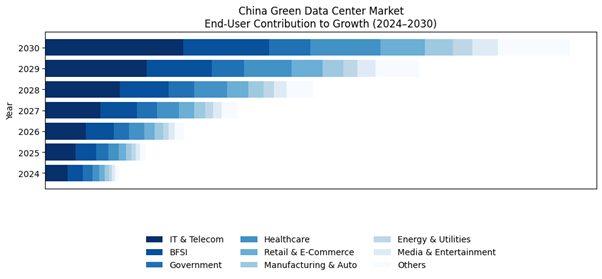
Sustained growth across IT & telecommunications (~35.6% CAGR), BFSI (~33.0%), healthcare (~47.1%), retail & e-commerce (~43.2%), media & entertainment (~44.4%), and manufacturing & automotive (~37.1%) reinforces long-term demand visibility. This diversified demand base reduces dependency on any single sector and positions green data centers as the default infrastructure choice across China’s digital economy.
Challenges :
High capital intensity driven by tier migration and scale concentration
China’s green data center expansion is structurally skewed toward Tier III and Tier IV facilities, which together account for ~85% of total market value by 2030, with Tier IV alone growing at ~35.5% CAGR. In parallel, large (20–100 MW) and mega/hyperscale (>100 MW) facilities collectively represent over 80% of capacity by value, with mega facilities expanding at ~37.2% CAGR.
This structural shift significantly raises upfront capital requirements due to:
N+1 / 2N power redundancy
Advanced liquid and hybrid cooling architectures
On-site substation upgrades and renewable interconnections
As a result, capital intensity per MW is materially higher than in legacy enterprise or Tier I/II facilities, extending payback periods despite strong long-term demand visibility.
Geographic imbalance in renewable availability and grid readiness
Although renewable integration is expanding rapidly—solar (~33.0% CAGR), wind (~30.8%), hybrid renewables (~30.5%), and nuclear (~42.1%)—access to low-carbon power remains uneven across China’s data center regions.
High-growth clusters increasingly rely on:
Hybrid renewable sourcing, rather than single-source renewables
Grid-linked renewable PPAs, which grow more slowly (~24.7% CAGR) than on-site or hybrid solutions
This reliance exposes operators to transmission bottlenecks, curtailment risks, and regional grid constraints, particularly as hyperscale campuses scale faster than renewable infrastructure in certain provinces.
Limited economic viability of brownfield retrofits
While greenfield construction dominates new capacity additions (~30.9% CAGR), brownfield retrofits grow at only ~21.3% CAGR, materially lagging the overall market.
The underlying challenge is structural:
Legacy facilities are predominantly small to medium (<20 MW) and Tier I/II
Retrofitting to Tier III/IV standards often requires complete redesign of power and cooling systems
Energy efficiency gains from retrofits are frequently inferior to purpose-built greenfield sites
As a result, operators increasingly favor new modular or greenfield developments over retrofitting, limiting the addressable retrofit opportunity despite China’s large installed base.
Rising operational complexity from density and energy diversification
China’s data center workloads are shifting rapidly toward high-density AI and cloud deployments, concentrated in hyperscale and edge environments. At the same time, energy sourcing is diversifying across solar, wind, hybrid, nuclear, and PPAs, increasing system complexity.
This creates operational challenges related to:
Load balancing across intermittent energy sources
Thermal management at higher rack densities
Maintaining uptime SLAs across multi-energy architectures
These factors increase dependence on advanced DCIM, BMS, and energy orchestration platforms, raising operational expenditure and execution risk, particularly for large campus operators.
What This Report Covers (China):
A data-driven view of China’s green data center ecosystem, anchored in the market’s expansion from USD 4.68 billion in 2024 to USD 23.20 billion by 2030, representing a ~30.8% CAGR driven by structural capacity additions rather than incremental upgrades.
A China-specific growth narrative, explaining how hyperscale (~34.1% CAGR) and colocation (~30.1% CAGR) infrastructure together account for the majority of incremental market value, while enterprise data centers grow at a materially slower ~23.1% CAGR.
A detailed examination of tier migration, highlighting how Tier III and Tier IV facilities increasingly define China’s green data center standard, driven by regulatory expectations, cloud SLAs, and ESG alignment.
An in-depth assessment of energy transition pathways, analyzing the relative acceleration of nuclear (~42.1% CAGR) versus solar, wind, and hybrid renewables, and the slower expansion of grid-based renewable PPAs.
A future-ready segmentation framework, enabling stakeholders to identify where demand is structurally shifting across facility sizes, deployment models, energy strategies, and end-user verticals.
Key highlights :
Robust investment growth mirrors China’s rapid market scaling, with the China green data center market growing from USD 4.68 billion (2024) to USD 23.20 billion (2030) at a ~30.8% CAGR. This expansion reflects sustained capital inflows from both domestic and global hyperscalers, strategic enterprise upgrades, and government-linked digital infrastructure programs, making China one of the most investible green DC markets worldwide.
Hyperscale and edge segments are magnetizing the bulk of greenfield and expansion capital, evidenced by ~34.1% CAGR for hyperscale and ~28.7% CAGR for edge, substantially outpacing traditional enterprise growth (~23.1% CAGR). Investors are prioritizing large cloud campus builds and distributed edge nodes because scale unlocks better power density, higher renewable integration, and superior sustainability metrics, which translates to stronger long-term returns.
Tier III and Tier IV expansions dominate capital allocation, with Tier IV facilities growing at ~35.5% CAGR and Tier III at ~29.6% CAGR. The premium placed on fault-tolerance, uptime SLAs, and compliance with stringent ESG standards is driving disproportionate funding into high-availability assets, as enterprises and hyperscalers seek to minimize risk while optimizing lifecycle costs.
Consolidation into large and mega/hyperscale facilities is driving investment concentration, as witnessed by ~37.2% CAGR in mega (>100 MW) facilities and ~28.8% CAGR for large (20–100 MW) data centers. These categories are attracting the lion’s share of capex because scale enables deeper renewable PPAs, lower PUEs, and efficiency arbitrage versus smaller facilities, making them more attractive to institutional capital.
Renewable energy deployment is a core investment theme, with solar (~33.0% CAGR), wind (~30.8%), hybrid renewables (~30.5%), and nuclear (~42.1%) energy sources growing significantly faster than the market overall. This reflects investor confidence in China’s energy transition agenda, where capital is being directed not just to capacity builds but to energy strategy diversification, including long-term PPAs and hybrid/firming solutions that lower operational risk.
Deployment model trends reveal where investment dollars are flowing most heavily — greenfield construction (~30.9% CAGR) and prefabricated modular builds (~34.5%) are outpacing brownfield retrofits (~21.3%). This suggests investors prefer new builds with standardized efficiencies and clear sustainability metrics, which are easier to value, scale, and integrate into portfolios than retrofit assets with unknown legacy risk.
End-user sector diversification enhances investment resilience — high growth from IT & telecommunications, alongside verticals such as healthcare, retail & e-commerce, and media & entertainment, signals that funding is not concentrated in a narrow band of adopters but spread across sectors with strong digital transformation demand, reducing revenue concentration risk for investors.
Key Questions Answered in This Report
- What are the key market trends and growth drivers?
- Who are the major players and what are their market strategies?
- What is the market size and forecast for the coming years?
- What are the regional market dynamics and opportunities?