Japan Green Data Center Market – Size, Share, Trends, Growth Forecast, and Competitive Analysis (2025–2030)
Report Summary
The Japan Green Data Center Market is segmented by Component (Solutions, Services), by Type (Hyperscale, Colocation, Enterprise, Edge), by Tier (Tier I, Tier II, Tier III, Tier IV), by Data Center Size (Small <5 MW, Medium 5–20 MW, Large 20–100 MW, Mega/Hyperscale >100 MW), by Energy Source (Solar, Wind, Hydroelectric, Nuclear, Hybrid Renewable, On-Site Generation vs Grid Renewable PPAs), by Deployment Model (Greenfield, Brownfield Retrofit, Prefabricated Modular, Containerized), by End User (IT & Telecommunications, BFSI, Government & Public Sector, Healthcare, Retail & E-Commerce, Manufacturing & Automotive, Energy & Utilities, Media & Entertainment, Other Industries), and by Geography (Japan)
Report Overview:
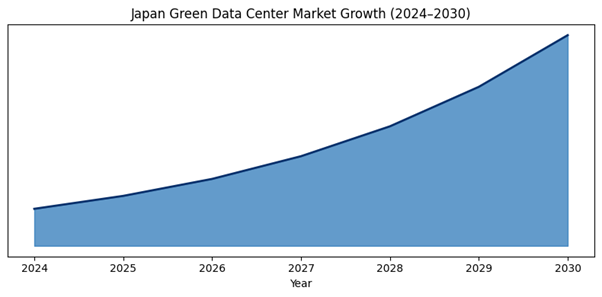
The Japan Green Data Center market is experiencing strong and structurally accelerating growth, supported by rising adoption of energy-efficient digital infrastructure, increasing pressure to optimize operating costs in a power-constrained environment, and tightening regulatory and ESG-oriented requirements. In 2024, the Japan green data center market is valued at approximately USD 2.01 billion and is projected to expand at a robust ~29.4% CAGR through 2030, reaching USD 9.90 billion by the end of the forecast period.
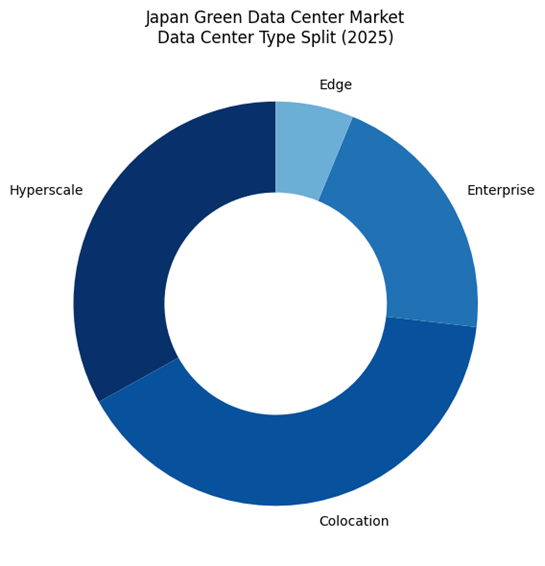
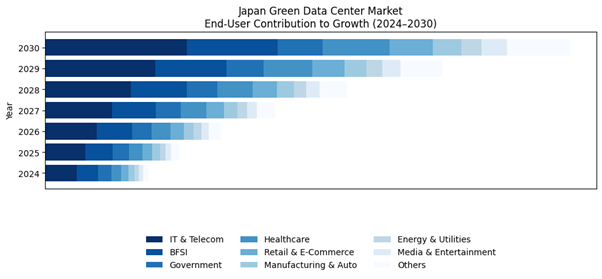
Market expansion is driven primarily by hyperscale and colocation data centers, which together account for the majority of incremental capacity additions, supported by steady enterprise demand and a rapidly scaling edge footprint. Increasing integration of solar, wind, hybrid renewable systems, and emerging nuclear power, combined with the dominance of greenfield and prefabricated modular deployment models, is reshaping Japan’s data center infrastructure. Strong demand from IT & telecommunications, BFSI, government, healthcare, retail & e-commerce, manufacturing, and energy & utilities sectors, alongside a growing emphasis on energy efficiency and ESG compliance, positions green data centers as a core pillar of Japan’s digital and sustainable infrastructure landscape.
Drivers :
Accelerating demand for energy-efficient digital infrastructure in a power-constrained market
Japan’s data center expansion is fundamentally shaped by the need to optimize energy consumption and manage high electricity costs. This is reflected in the market’s growth from USD 2.01 billion in 2024 to USD 9.90 billion by 2030 (~29.4% CAGR), as operators increasingly prioritize green designs to achieve lower PUE, higher power density, and long-term cost stability.
Hyperscale and colocation expansion driven by cloud, AI, and enterprise outsourcing
Investment momentum is concentrated in hyperscale (~33.9% CAGR) and colocation (~30.0% CAGR) facilities, as Japanese enterprises continue migrating workloads to cloud platforms and third-party data centers. This shift reduces reliance on legacy enterprise infrastructure (~23.0% CAGR) and favors large, energy-optimized facilities capable of supporting AI workloads, digital services, and latency-sensitive applications.
Structural migration toward higher-tier data centers
Japan is witnessing a clear transition toward Tier III and Tier IV data centers, which together account for the majority of capacity additions. Tier IV facilities (~35.3% CAGR) are expanding significantly faster than Tier I and Tier II, driven by stringent uptime requirements, disaster resilience considerations, and regulatory expectations around business continuity and reliability.
Growth in large and mega data centers to support efficiency at scale
Capacity expansion is increasingly concentrated in large (20–100 MW, ~28.7% CAGR) and mega/hyperscale (>100 MW, ~37.1% CAGR) facilities. These formats enable deeper renewable integration, advanced cooling systems, and standardized greenfield designs, making scale a key enabler of sustainability and operational efficiency in Japan.
Rising integration of diversified low-carbon energy sources
Japan’s green data center investments are supported by steady expansion across solar (~32.8% CAGR), wind (~30.7%), hybrid renewable systems (~30.4%), and emerging nuclear (~41.9%) energy sourcing. This diversified energy mix reflects a strategic shift away from single-source procurement toward resilient, low-carbon power strategies aligned with long-term energy security goals.
Strong uptake of greenfield and modular deployment models
The dominance of greenfield construction (~30.7% CAGR) and prefabricated modular deployments (~34.4%) highlights Japan’s preference for new, purpose-built facilities with predictable performance and sustainability outcomes. These models allow faster rollout, standardized efficiency benchmarks, and reduced retrofit risk compared with legacy infrastructure.
Broad-based demand from digitally intensive end-user sectors
Sustained growth across IT & telecommunications, alongside strong acceleration in healthcare, retail & e-commerce, and media & entertainment, reinforces long-term demand visibility. This diversified end-user base reduces dependency on any single sector and supports continued investment in green data center infrastructure.
Challenges :
● High capital intensity of resilient, high-tier infrastructure
Japan’s green data center market is structurally skewed toward high-availability infrastructure, with Tier III and Tier IV together accounting for ~66% of total market value by 2030, up from ~58% in 2024. Tier IV alone grows at ~35.3% CAGR, materially faster than Tier I (~20.7%) and Tier II (~24.6%).
This tier mix significantly increases capex per MW, as facilities must incorporate seismic-resilient civil design, N+1/2N power redundancy, advanced cooling, and fault-tolerant electrical systems. The challenge is amplified by Japan’s construction cost inflation and engineering intensity, resulting in longer payback cycles despite strong utilization and demand visibility.
● Geographic and structural constraints on renewable energy availability
Although renewable integration is accelerating, Japan’s energy sourcing profile remains structurally constrained by geography and grid limitations. By 2030, solar (~34.5% of energy mix), wind (~26.3%), and hybrid renewables (~18.0%) dominate green sourcing growth, while grid-linked renewable PPAs grow at only ~24.6% CAGR, materially below the market average (~29.4%).
This divergence reflects limited grid flexibility and congestion near high-demand metro regions such as Greater Tokyo and Kansai, where hyperscale and colocation capacity is concentrated. As a result, operators increasingly rely on hybrid and baseload-oriented sourcing, which improves resilience but raises system complexity and limits site optionality.
● Limited economic viability of brownfield retrofits
Brownfield retrofits expand at only ~21.2% CAGR, compared with ~30.7% for greenfield and ~34.4% for prefabricated modular deployments. By 2030, brownfield accounts for <9% of total market value, down from ~13% in 2024.
This reflects the structural difficulty of upgrading legacy enterprise facilities to meet modern Tier III/IV standards, seismic codes, and energy efficiency thresholds. Retrofit projects often involve higher per-MW costs, partial downtime, and constrained design flexibility, accelerating economic obsolescence of older enterprise assets and widening the performance gap versus new builds.
● Operational complexity from high-density, multi-energy environments
Japan’s capacity expansion increasingly favors large (20–100 MW, ~28.7% CAGR) and mega/hyperscale (>100 MW, ~37.1% CAGR) facilities, which together represent ~80% of incremental capacity additions by 2030. These facilities support higher rack densities and AI-ready workloads, driving up thermal loads and power volatility.
Simultaneously, nuclear (~41.9% CAGR), solar (~32.8%), wind (~30.7%), and hybrid renewables (~30.4%) are all scaling in parallel, resulting in multi-source energy environments. Managing uptime, power quality, and thermal efficiency across such configurations requires advanced DCIM, predictive maintenance, and specialized operational talent—raising opex intensity and execution risk, particularly during rapid scale-up phases.
What This Report Covers :
A quantified assessment of Japan’s green data center ecosystem, grounded in the market’s expansion from USD 2.01 billion (2024) to USD 9.90 billion (2030) at ~29.4% CAGR, with emphasis on structural drivers rather than cyclical demand.
A Japan-specific growth narrative, explaining how hyperscale (~33.9% CAGR) and colocation (~30.0% CAGR) investments are reshaping capacity economics and reinforcing Japan’s strategic position within APAC.
Detailed evaluation of infrastructure migration, showing the declining relative importance of enterprise data centers (~23.0% CAGR) versus hyperscale-, colocation-, and edge-led architectures.
In-depth analysis of sustainability pathways, highlighting the rising role of nuclear as a baseload stabilizer alongside solar, wind, and hybrid systems in a grid-constrained market.
A forward-looking segmentation framework, mapping demand shifts across tiers, sizes, energy strategies, and end-user industries to identify where structural acceleration or saturation is likely.
Key Questions Answered in This Report
- What are the key market trends and growth drivers?
- Who are the major players and what are their market strategies?
- What is the market size and forecast for the coming years?
- What are the regional market dynamics and opportunities?