Amana AI - AI Governance C Compliance Fabric (Multi-framework)
DataMind AI RegTech Group markets privacy C AI governance solutions, advisory, and training while Amana is the featured product. Amana AI is a governance-as-code fabric that harmonizes multiple AI frameworks (ISO/IEC 42001, GDPR/DIFC DPL, NIST AI RMF, EU AI Act, Dubai AI Ethics) into one operating method with an AI system registry, consent C DSR workflows, risk classification, evidence/technical-file automation, runtime oversight, and regulator-grade reporting and live oversight dashboards for data subjects, organizations, and regulators. Core Outcome: convert paperwork-heavy AI compliance into programmable governance—reducing audit effort and accelerating safe deployment.
IHR INSIGHTS – DECISION SPOTLIGHT: Amana AI
Executive Summary
Amana AI (by DataMind AI RegTech Group)
Category: AI Governance C Compliance Fabric (Multi-framework)
Geographies: APAC, Middle East (UAE/GCC), Global
Audience: CIO, CDO, CISO, Chief AI Officer, CRO/Compliance, DPO, Heads of Risk C Legal
Company Snapshot
· Brand / product: Amana AI (styled “Amana”): a “governance-as-code” platform under DataMind AI RegTech Group. The group’s flagship product is Amana followed by Navo, myCityID and HubbPaw.
· Operating jurisdiction / legal venue: DIFC (Dubai International Financial Centre) Dubai
· Founding year: 2025 for DataMind AI RegTech Group (publisher of Amana AI).
· Founder / CEO: Ms. Agne Ivanauskaite Founder C CEO, DataMind AI RegTech Group.
· Ownership: Privately held
What the company does
DataMind AI RegTech Group markets privacy C AI governance solutions, advisory, and training while Amana is the featured product.
Amana AI is a governance-as-code fabric that harmonizes multiple AI frameworks (ISO/IEC 42001, GDPR/DIFC DPL, NIST AI RMF, EU AI Act, Dubai AI Ethics) into one operating method with an AI system registry, consent C DSR workflows, risk classification, evidence/technical-file automation, runtime oversight, and regulator-grade reporting and live oversight dashboards for data subjects, organizations, and regulators.
Core Outcome: convert paperwork-heavy AI compliance into programmable governance—reducing audit effort and accelerating safe deployment.
Market context
Global shift from principles to enforcement. Over the next 12–36 months, AI governance is moving from advisory guidance to hard obligations. The EU AI Act introduces risk-based duties (registry, risk classification, technical files, post-market monitoring), while privacy and sector regulators are tightening expectations that AI decisions are explainable, fair, and auditable. In parallel, ISO/IEC 42001 gives enterprises a management-system blueprint for operationalizing AI controls—so boards are now asking for measurable evidence, not policy decks.
What buyers are funding: build-once, comply-many operating layers that:
1) inventory AI systems and their data/third parties,
2) map controls across multiple frameworks,
3) produce regulator-ready evidence automatically, and
4) keep engineers productive via integrations to CI/CD and model registries. Spend is shifting from paper checklists to programmable governance (policy-as-code, automated conformity checks, evidence graphs).
Regional snapshots:
· European Union: Phased enforcement of AI-risk obligations is accelerating investments in system registries, conformity assessments/technical files, post-market monitoring, and downstream incident reporting—especially for high-risk and foundation-model-based use-cases. Buyers look for tight alignment with GDPR and emerging harmonized standards (e.g., ISO 42001 family) and expect templates they can hand to Notified Bodies and internal audit.
· Middle East (UAE/GCC): DIFC DPL and Dubai AI Ethics have made governance a board issue. Public-sector programs, smart-city initiatives, and regulated FSI/health organizations require data residency/sovereignty, regulator-visible oversight, and practical toolkits for third-party/vendor models. Expect buyer requests for VPC/Sovereign deployments, Arabic localization, and audit-grade documentation that aligns with local principles while remaining EU-compatible.
· APAC: Singapore continues to lead with pragmatic model governance toolkits (e.g., industry frameworks and sandboxes), while financial-services guidance (e.g., fairness, accountability, transparency) is pushing banks/insurers to formalize AI model inventories and controls. Australia is advancing risk-based approaches alongside privacy reforms; Japan emphasizes safety and transparency for industry deployments; India’s evolving privacy regime and the scale of Global Capability Centers create demand for multi-jurisdiction rollouts managed from APAC hubs.
Buying behaviour s metrics: The first purchase is usually an AI System Registry + Risk Classification + Technical File/Evidence package, owned by CAIO/CDO/DPO with CISO and Legal. Expansion lands in runtime monitoring, consent/DSR linkage, and regulator reporting. Success is measured by time-to-approval, audit hours saved, # of AI systems onboarded per quarter, time-to-respond to regulator inquiries, and reduction in compliance findings.
Product Modules (what ships)
1. AI System Registry – inventory of AI/ML/GenAI systems, owners, data sources, third parties, and lifecycle state.
2. Risk s Control Mapping – risk taxonomy and rule-mapping across ISO 42001, GDPR/DIFC, NIST, EU AI Act, Dubai AI Ethics.
3. Consent s Data Subject Rights – link consent/preference signals to features, prompts, and downstream decisions.
4. Evidence s Technical Files – structured documentation, logs, attestations, conformity checks, exportable technical files.
5. Runtime Monitoring s Live Alerts – deployment oversight, incident flags, non-conformity detection.
6. Oversight s Reporting – dashboards oriented to organizations and regulators/supervisors.
Integration priorities: model registries/ML platforms (MLflow, Azure ML, SageMaker, Vertex), ticketing (Jira/ServiceNow), data catalogs/PII discovery, SIEM/log stores, SSO/IDP.
Deployment: SaaS and private VPC options; data-residency configurations (EU/UAE/SG) and RBAC.
Implication for Amana: A binding layer across ISO 42001, GDPR/DIFC, NIST AI RMF, EU AI Act, and Dubai AI Ethics—combined with consent-aware workflows and regulator-grade oversight—addresses exactly what buyers now prioritize.
To keep advantage as enforcement bites, Amana should:
1) maintain a continuously updated controls library,
2) deepen native integrations (MLflow/Azure ML/SageMaker/Vertex, Jira/ServiceNow, SIEM), and
3) publish quantified ROI (speed-to-approve, audit effort reduction, incident avoidance) from lighthouse accounts.
SCOT analysis (Strengths • Challenges • Opportunities • Threats)
Strengths
· Binding layer across standards (ISO 42001, GDPR/DIFC, NIST, EU AI Act, Dubai AI Ethics) with a single governance method.
· Three-sided design: artifacts and views for Data Subjects, Organizations, and Regulators (oversight dashboards, live alerts).
· Consent-aware workflows connected to AI use-cases (rare among AI-risk tools).
· Evidence C conformity: documentation, logs, deployment checks geared to technical files/audits.
· Message that resonates: “Trust in AI starts here.”
Challenges
· Needs deep, out-of-the-box MLOps integrations (MLflow, SageMaker, Vertex, Azure ML) to capture runtime evidence automatically.
· LLM red-teaming/guardrails/evals likely lighter than Lakera/LLM-security specialists.
· Must show quantified ROI beyond compliance (audit hours saved, time-to-approve, incidents prevented).
· Will face procurement gravity toward incumbents (clouds, OneTrust/BigID, IBM).
Opportunities
· EU AI Act + local regimes (DIFC/UAE ethics; Singapore’s governance frameworks; Australia/Japan guidance) → clear budget lines.
· Public sector C FSI in UAE/Saudi/Singapore seeking regulator-visible systems and data-residency.
· “Network-aware” governance across vendors/partners is a gap in most tooling.
· Partner-led expansion via Big 4, law firms, and local risk/assurance boutiques.
Threats
· Incumbent bundling: clouds harden “good-enough governance” inside their MLOps; privacy leaders layer AI modules.
· Standard volatility and policy mismatch across regions.
· Long enterprise sales cycles; price pressure from GRC suites.
Product–Market Fit (PMF)
Compelling JTBDs (jobs-to-be-done)
1. Create and maintain an AI system registry with lineage to datasets/prompts/vendors.
2. Classify risk and generate technical files with mapped controls and evidence.
3. Link consent/DSR to ML features/inference and prove lawful basis.
4. Continuously monitor deployments with live alerts and conformity checks.
5. Report to regulators (or internal audit) with one click.
Strong early PMF signals: regulated verticals (banks/fintech, insurers, health providers, public sector) that must operate across EU + UAE/APAC.
Gaps to close for durable PMF: native LLM eval/red-team options and first-class integration with CI/CD + ML registries.
Differentiators - Amana vs others
1. Binding layer across standards: one method mapped to ISO 42001, GDPR/DIFC DPL, NIST AI RMF, EU AI Act, and Dubai AI Ethics.
2. Three-sided ecosystem: artifacts and workflows designed for Data Subjects, Organizations, and Regulators (e.g., oversight dashboards, live alerts).
3. Consent-aware AI: integrated consent C preferences workflows linked to model use cases.
4. Evidence graph: structured documentation, logs, and conformity checks for technical files and audits.
5. Network-aware governance: supports cross-organization visibility where models and data traverse vendors and partners.
IDEAL BUYERS & USE CASES
Ideal Customer Profile (ICP)
· Industries: Banking/Payments, Insurance, HealthTech/providers, Public Sector/Smart City, Telco, high-growth AI product companies.
· Firmographics: 2+ AI use-cases in production; multi-jurisdiction operations (EU + UAE/APAC); dedicated risk/privacy teams; cloud-native engineering.
· Personas: CAIO/Head of ML, CDO/CIO, DPO/GC, Head of Risk/Compliance, Internal Audit, CISO.
Top triggers: EU AI Act programs; regulator inquiries; personalization rollouts involving consent; third-party model oversight; internal mandates for an AI registry.
Representative Use Cases
· EU AI Act Readiness: risk classification, control mapping, and exportable technical files for high-risk systems.
· Enterprise AI System Registry: inventory + ownership + lineage to datasets/prompts/vendors.
· Consent-aware Personalization: enforce consent across training/inference with auditable traces.
· Third-party/Vendor Model Governance: due-diligence packs, runtime oversight, and escalation workflows.
· Regulator/Supervisor Reporting: regulator-visible dashboards and conformity attestations.
Packaging s Architecture (Signals)
· Platform: governance hub, registries, templates, evidence vault, dashboards, and live alerts.
· Connectors: model registries (e.g., MLflow/Azure ML/SageMaker/Vertex), data catalogues/PII discovery, ticketing (Jira/ServiceNow), IDP/SSO, log stores.
· Deployment: cloud/SaaS; regional residency; private VPC for regulated markets.
· Professional Services: onboarding of frameworks and organizational controls; regulator-grade documentation.
Competitive Lens (Snapshot)
· AI Governance Platforms: Credo AI, Holistic AI, IBM watsonx.governance
o Amana edge: multi-framework binding layer, consent workflows, regulator-grade views.
· Model Risk s Observability: Arthur, Fiddler, Monitaur
o Peer edge: deeper model performance/quality analytics;
o Amana need: stronger out-of-box MLOps integrations.
· LLM Security/Guardrails: Lakera, Protect AI
o Peer edge: red-teaming and eval suites;
o Amana need: turnkey LLM testing bundles with auto-evidence capture.
· Privacy/GRC Suites: OneTrust, BigID, TrustArc
o Peer edge: data discovery and privacy ops depth.
o Amana edge: AI-specific registries, risk rules, technical-file automation.
Quick Scorecard (IHR indicative)
Capability | Score (1–5) | Notes |
Multi-framework mapping | 5 | Clear focus on ISO 42001/GDPR/DIFC/NIST/EU AI Act/Dubai Ethics |
AI system registry | 4 | Needs broad connectors to be system-of-record |
Consent C DSR linkage | 5 | Differentiated angle vs AI-risk peers |
Evidence C technical files | 4 | Strong templates; expand automation/integrations |
Runtime monitoring C alerts | 3 | Good for conformity; deepen model metrics |
MLOps integrations | 3 | Prioritize MLflow/SageMaker/Vertex/Azure ML |
LLM guardrails/evals | 3 | Add red-team/eval packs |
Regulator reporting/oversight | 5 | Three-sided views incl. regulators |
Residency C controls | 4 | EU/UAE/SG options; document KMS/keys |
Capability Heatmap
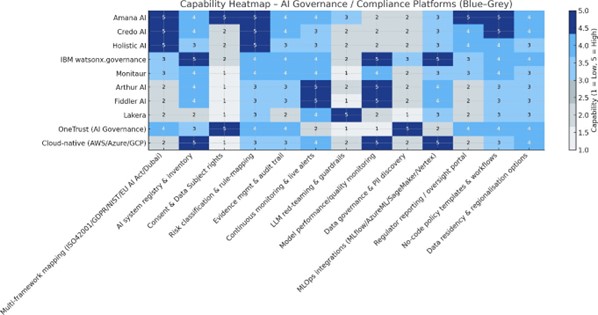
Opinions & Methodology. Capability scores, heat maps, and competitive characterizations are opinions based on our methodology, assumptions, and vendor/public materials as of October 2025; they are directional, not statements of fact, and not a substitute for buyer testing or RFPs. Vendors may submit factual corrections with evidence at the contact listed herein.
Commentary: This heat map tells where Amana AI shines, and where the gaps and partner plays are.
How to read this
· Vendors: Amana AI, Credo AI, Holistic AI, IBM watsonx.governance, Monitaur, Arthur, Fiddler, Lakera, OneTrust (AI Governance), and “Cloud-native” (AWS/Azure/GCP governance features).
· Capabilities: 13 items from multi-framework mapping through data residency.
· Scale: 1–5 (indicative), with numbers printed in each cell for quick comparison.
Topline takeaways
1. Two clusters dominate the landscape.
o Governance/policy-first (Amana, Credo, Holistic, OneTrust): excel at mapping obligations across standards, technical-file/evidence, consent C workflows, and regulator-oriented reporting.
o Model-risk/ops-first (IBM + cloud platforms; Arthur/Fiddler/Monitaur): excel at runtime monitoring, quality, and MLOps integrations; lighter on consent/privacy workflows and multi-framework legal mapping.
2. Amana’s signature strengths sit in multi-framework binding, consent/DSR, risk rule-mapping, technical-file/evidence, no-code policy workflows, regulator reporting/oversight, and data- residency options. That positions Amana as the governance fabric you stand up when EU AI Act + local regimes converge.
3. Where Amana should push: deeper MLOps integrations (MLflow/Azure ML/SageMaker/Vertex), stronger runtime/observability for model quality, and turnkey LLM red-teaming/evals. Those are the places observability vendors and clouds currently lead.
Capability-by-capability commentary
1. Multi-framework mapping (ISO 42001 / GDPR-DIFC / NIST / EU AI Act / Dubai ethics)
o Leaders: Amana, Credo, Holistic.
o Runners-up: OneTrust (strong privacy roots); IBM/clouds trail here.
o So what: Buyers doing “build once, comply many” will shortlist Amana and Credo/Holistic first.
2. AI system registry s inventory
o Leaders: IBM and cloud platforms (tight to their MLOps stacks).
o Amana: solid (4) but rises/falls with connector depth and ability to be the system-of- record across mixed estates.
3. Consent s Data Subject rights
o Leaders: Amana and OneTrust.
o Rest: generally weak—governance/AI-risk tools rarely tie consent to features/prompts/inference.
o So what: For personalization and lawful-basis scrutiny, Amana differentiates.
4. Risk classification s rule-mapping
o Leaders: Amana, Credo, Holistic, with OneTrust close.
o Ops-first players: adequate but not deep on legal/rule harmonization.
5. Evidence management s audit trail
o Strong: Amana, Credo, OneTrust; IBM/Monitaur also competent.
o Key nuance: Automating evidence from pipelines (vs manual uploads) is the unlock—ties back to MLOps connectors.
6. Continuous monitoring s live alerts
o Leaders: Observability set (Arthur/Fiddler/Monitaur) and IBM/clouds.
o Amana: mid-pack—good for conformity alerts; less focused on model quality metrics.
7. LLM red teaming s guardrails
o Leader: Lakera (security/testing focus).
o Amana s others: have coverage but not as turnkey as specialists.
o Action: ship prebuilt test suites with auto-evidence capture.
8. Model performance / quality monitoring
o Leaders: Arthur/Fiddler/Monitaur and IBM/clouds (native MLOps).
o Amana: lower here by design; governance rather than observability.
o Partner play: bundle with an observability leader for production AI.
9. Data governance s PII discovery
o Leader: OneTrust (privacy DNA); others light.
o Amana: purposefully not a discovery tool—integrate with privacy/data-catalogue stacks.
10. MLOps integrations (MLflow / Azure ML / SageMaker / Vertex)
· Leaders: IBM and cloud platforms.
· Amana: mid; must become plug-and-play to auto-harvest evidence and lineage.
11. Regulator reporting / oversight portal
· Leaders: Amana, OneTrust.
· Ops players: rarely offer regulator-grade views out-of-the-box.
· So what: This is pivotal for EU AI Act/DIFC/sector supervisors.
12. No-code policy templates s workflows
· Leaders: Amana, Credo, OneTrust.
· Others: more engineer-centric; lighter on governance workflows.
13. Data residency s regionalization
· Strong: Amana, IBM/clouds, OneTrust; key for UAE/EU/SG.
· Buyer ask: VPC/Sovereign cloud, KMS/CMK control, documentation for audits.
How the vendor’s “stack”
· Amana AI (governance fabric): Best pick when you need standard harmonization, consent linkage, regulator-visible reporting, and technical files. Pair with observability/LLM-security vendors to cover runtime and red-team depth.
· Credo/Holistic (policy-first): Strong control mapping and assessments; lighter on consent and runtime.
· IBM watsonx.governance / Cloud-native stacks: Great MLOps and model-quality alignment; rely on partners or add-ons for legal/rule harmonization and consent.
· Arthur/Fiddler/Monitaur: Best-in-class for performance/quality monitoring; not designed as multi-framework compliance layers.
· Lakera: Sharp for LLM guardrails/red-teaming; pair with a governance fabric for controls and evidence.
· OneTrust (AI Gov): Excellent consent/PII and workflows; lighter on model-risk and runtime.
Regional fit
· UAE/GCC: Favor Amana for regulatory oversight + residency; pair with OneTrust (privacy ops) and a runtime monitor for production AI.
· EU: Amana + Credo/Holistic are strong for EU AI Act technical files; add IBM/cloud-native or observability where model metrics matter.
· Singapore/Australia/Japan: Blended regimes; Amana’s harmonization + reporting is compelling, provided connectors are ready.
· US sectoral: Heavier weight on runtime/observability → pair Amana with IBM/observability tools.
Buyer guidance
· Choose Amana when your priority is getting a defensible AI System Registry, risk classification, and exportable technical files across multiple regimes—and you need consent visibly enforced.
· Bundle wisely:
o Amana + Observability (Arthur/Fiddler/Monitaur) → end-to-end governance + model quality.
o Amana + OneTrust → deep privacy/PII + AI governance harmonization.
o Amana + Lakera → LLM testing with automatic evidence into the technical file.
· Integrations win: insist on connectors that auto-create evidence from your CI/CD and ML pipelines.
Roadmap priorities for Amana (based on gaps)
1. Native MLOps connectors (MLflow, SageMaker, Vertex, Azure ML) + policy-as-code tests that run in CI/CD.
2. LLM security packs (jailbreak/prompt-injection, PII/PHI, toxicity) with one-click evidence export to technical files.
3. Operational KPIs in product: time-to-approval, audit hours saved, systems onboarded/quarter, regulator response time.
4. Partner kits for Big 4 / law firms / local risk boutiques; prebuilt EU AI Act C DIFC packs with templates and attestations.
Bottom line
· The heatmap shows no single vendor is best at everything.
· Amana leads where AI governance intersects with law, consent, and regulators.
· To win big, pair that fabric with runtime/LLM security and MLOps depth—either natively or via tight partnerships—so governance is both audit-ready and production-grade.
Buyer’s Checklist (What to Validate)
A. Strategy s Scope
· Executive sponsorship + RACI across CAIO/CDO/DPO/CISO/Legal/Internal Audit.
· Define first 2–3 priority AI use-cases and target jurisdictions (EU AI Act, DIFC/UAE, SG, AU, JP, US sectoral).
· Request a controls-mapping matrix showing how ISO/IEC 42001, GDPR/DIFC DPL, NIST AI RMF, EU AI Act, and Dubai AI Ethics are reconciled. Confirm conflict-resolution logic.
B. System of Record (Registry) s Risk Classification
· Validate the AI System Registry schema: asset ID, owners, datasets/prompts, models/vendors, training/inference environments, versions, lineage, approvals.
· Import test from spreadsheet/API; confirm de-duplication and versioning.
· Review risk taxonomy (impact/likelihood/harms/safety). Ensure rule-mapping drives obligations and technical-file sections.
C. Evidence s Technical Files
· Inspect template packs for high-risk and limited-risk systems (model cards/data sheets, DPIA/DTIA, test plans, human oversight, robustness/bias).
· Validate automatic evidence capture from CI/CD and ML registries (training configs, eval results, approvals, hashes).
· Check immutability (timestamps, signatures, chain-of-custody) and export formats (PDF, JSON, CSV) acceptable to regulators/auditors.
· Confirm change-log and traceability of decisions/exceptions/waivers.
D. Runtime Controls s Monitoring
· Out-of-box policy-as-code tests (purpose limitation, data residency, risk mitigations) and non-conformity alerts.
· Incident management: linkage to Jira/ServiceNow, severity model, runbooks, and post-incident reporting into the technical file.
· GenAI/LLM: availability of red-team/eval suites (prompt injection, jailbreaks, PII/PHI leakage, toxicity); auto-evidence capture.
E. Privacy, Consent s DSR
· Demonstrate consent linkage from data-subject choices to features/prompts/inference decisions with auditable traces.
· Region-specific notices/preferences and DSR workflows (access/erase/opt-out) reconciled with the AI registry.
· Prove purpose limitation/data minimization policies are enforceable and testable.
F. Integrations
· MLOps: MLflow, Azure ML, SageMaker, Vertex (metadata scope + frequency).
· Tooling: SIEM/logs, data catalogs/PII discovery (Collibra/OneTrust/BigID), ticketing (Jira/ServiceNow), SSO/IDP (SAML/OIDC), DLP.
· Request a connector inventory with versions, support SLAs, and known limitations; run a live import in the pilot.
G. Security, Residency s Compliance
· Deployment options: SaaS vs private VPC/sovereign; supported regions (EU, UAE, SG).
· Encryption s keys: BYOK/CMK, KMS/HSM, rotation policy; at-rest/in-transit details.
· Access: RBAC/ABAC, SoD, least-privilege, admin trails; API scopes and audit logs.
· Assurance: SOC 2/ISO 27001, pen-tests, vulnerability management; DPAs/SCCs and sub-processor list.
H. Operations, Content s Support
· SLA/uptime, RTO/RPO, maintenance windows, support tiers/hours, and named CSM.
· Regulatory content cadence: how fast control libraries are updated; versioning and release notes.
· Training C enablement for admins, engineers, auditors, and business owners; sandbox environment.
I. Implementation s Adoption
· 30-60-90 day onboarding plan; required roles (yours vs vendor/partner).
· Change management: exception/waiver process, approvals, and governance board.
· Migration from spreadsheets/legacy tools; data exit/portability terms.
J. Commercials s Outcomes
· Pricing metric (per system/use-case/seat/storage); PS scope and rate card; renewal uplifts.
· Contractual success metrics: time-to-first technical file, audit hours saved, systems onboarded/quarter, regulator response time, reduction in non-conformities.
· Customer references (preferably regulated) and, if possible, regulator/supervisor engagement proof.
Red-flags
· Manual evidence only (no pipeline capture), weak consent/DSR linkage, no exportable technical files, vague control mappings, no residency options, unclear DPA/sub-processors, absence of implementation playbooks.
Analyst Point of View
Thesis. Amana AI is a governance fabric purpose-built for multi-jurisdiction deployments. Its strengths— binding multiple frameworks, consent-aware workflows, regulator-grade reporting, and evidence/technical-file automation—align with how boards now measure readiness.
Fit. Choose Amana when your north-star is “build once, comply many” across EU AI Act + UAE/DIFC + APAC governance, and when consent/lawful basis must be demonstrably enforced. It is especially effective in FSI, insurance, health, public sector/smart city, and telco.
What to add. Pair with model observability (Arthur/Fiddler/Monitaur or cloud-native) and LLM security/testing (e.g., Lakera) to achieve production-grade assurance. Integrate privacy/data discovery platforms for catalogue depth.
Go-to-market guidance. Start with a 30–45-day pilot delivering:
(1) AI System Registry,
(2) risk classification,
(3) the first technical file for a high-risk use-case, and
(4) at least two CI/CD integrations capturing automated evidence.
Report outcomes as: time-to-approval, audit hours saved (≥50%), non-conformities caught, and regulator response time improvement.
Risks s counters. Incumbent bundling by clouds/GRC suites and integration lift. Counter with certified connectors, a living controls library, and alliances (Big 4, law firms, local risk boutiques, cloud marketplaces).
Verdict. A credible Challenger. With integrations treated as first-class and LLM/observability depth added natively or via partners, Amana should accelerate compliant AI deployment while holding its own against larger suites.
Disclaimer
Purpose & non-Reliance
This report is provided for informational purposes only to assist the recipient in evaluating market dynamics and potential solutions. It does not constitute legal, financial, tax, accounting, or investment advice, and no decision should be made in reliance upon it without independent professional advice appropriate to your circumstances.
Sources, Assumptions & Accuracy
The analyses herein reffect a combination of primary materials provided by Coolect, third-party information believed to be reliable, and our own assumptions and models. We do not independently audit or verify third-party data. All information is provided “as is,” without warranties of any kind, and may be incomplete or subject to change without notice.
Forward-Looking Statements
Any statements about expected benefits, performance, timelines, market size, pricing, or adoption are forward-looking and involve known and unknown risks and uncertainties. Actual results may differ materially. We assume no obligation to update forward-looking statements.
Regulatory & Compliance
References to regulations (including telecom, privacy, data protection, recording/consent, consumer, or sector- specific rules) are general in nature and not legal advice. Applicability varies by jurisdiction and use-case. You are responsible for obtaining your own legal counsel and ensuring compliance with all applicable laws before implementation or use.
Third-Party Products & Trademarks
All third-party product names, logos, and trademarks are the property of their respective owners and are used for identification only. Inclusion does not imply endorsement, affiliation, or sponsorship.
No Offer / No Solicitation
Nothing herein constitutes an offer to sell or a solicitation to buy any product, service, security, or instrument, nor a commitment to enter into any agreement. Any engagement is subject to separate, definitive written terms agreed by the parties.
No Warranties; Limitation of Liability. This report is provided “as is” without warranties of any kind. To the maximum extent permitted by law, we (and our affiliates, officers, employees, and contractors) are not liable for any indirect, incidental, special, consequential, exemplary, or punitive damages, or for any loss of profits, revenue, data, goodwill, or business interruption, arising from or related to this report or reliance on it, even if advised of the possibility of such damages. Our aggregate liability for any claim relating to this report shall not exceed USD 500 or the amount paid for access in the 12 months before the claim, whichever is greater. This clause does not limit liability for fraud or for death or personal injury to the extent such limitation is not permitted by law.
No Reliance; Independent Compliance. You acknowledge that you alone are responsible for legal, regulatory, telecom, and privacy compliance (including consent/recording, DNC/TCPA/PDPL/PECR-style regimes, data export, and sector rules). You agree not to rely on this report as legal advice and to obtain independent counsel before implementation.
License & Restrictions. We grant a limited, non-transferable license to access this report for your internal evaluation only. You may not reproduce, distribute, or create derivatives without our written consent. Access or download constitutes acceptance of these terms.
Attribution. Roadmaps, pricing, performance targets, SLAs, and compliance postures referenced herein are as represented by the named vendor(s) at the time of drafting and were not independently audited by us.
Severability. If any provision of these terms is found unenforceable, the remaining provisions will remain in full force and effect.
Confidentiality & Distribution
This report is intended solely for the addressee’s internal use and may contain confidential information. Do not distribute, reproduce, or disclose without our prior written consent. If you are not the intended recipient, please notify us and delete all copies.
No Endorsement. Inclusion of any vendor or competitor does not constitute endorsement; trademarks belong to their owners. Our findings reffect our independent judgment as of the date of publication and may change without notice.
Prepared by: IHR Insights • Report: Vendor Spotlight • Date: October 2025 • Contact: sreeni@ihrinsights.com
Assent - Accessing, downloading, or sharing this report constitutes acceptance of these terms.
About IHR Insights:
IHR Insights is an independent research and advisory firm delivering market intelligence, custom research, and go-to-market consulting across ICT/Cloud, Data & AI, Security/Telecom, GCC and Healthcare. Beyond vendor/product evaluations, we run primary & secondary research, competitive/benchmark studies, opportunity assessment & market entry, and executive content development (CXO reports, buyer guides).
Our publications stay vendor-neutral and evidence-based—grounded in live product walk-throughs, reference checks, and scenario testing—so leaders can move from slideware to measurable outcomes with clear fit, value, and risk signals. www.ihrinsights.com
Independent research provided “as is”, no warranties or liability. No endorsement or professional advice. Findings may change without notice.
Disclaimer & Limitation of Liability. This report is independent, vendor-neutral research and is provided “as is,” for informational purposes only. IHR Insights makes no warranties (including accuracy, completeness, timeliness, merchantability, fitness, or non-infringement) and disclaims liability, to the maximum extent permitted by law, for any loss or damages arising from use of or reliance on this report. No endorsement or professional advice is implied. Findings reflect IHR Insights opinions as of the publication date and may change without notice; no duty to update is assumed.
Corrections. If you believe this report contains a factual error or uses your IP beyond fair use, email sreeni@ihrinsights.com with supporting evidence; we will review and, if substantiated, issue a correction or takedown within 10 business days.