Atmoz | Conversational, Proactive Real time FinOps for the AI- Driven Enterprise
Why it matters: Organizations that embed guardrails where engineers work can curb 15–20% waste within 30 days and realize 3–5x ROI in a quarter, while linking cost to carbon and compliance outcomes.
Atmoz | Conversational, Proactive Real time FinOps for the AI- Driven Enterprise
Executive Summary
Cloud costs are now a board-level issue, compounded by AI/ML workload sprawl and sovereignty pressures. Traditional, billing-based FinOps tools surface problems after budgets are blown. Atmoz takes a prevention-first approach: it operates on resource telemetry in real time, pushes contextual alerts to the right owner in Slack/Teams/WhatsApp, and offers one-click fixes, turning cost governance into an in-workflow habit rather than an after-the-fact report.
Why it matters: Organizations that embed guardrails where engineers work can curb 15–20% waste within 30 days and realize 3–5x ROI in a quarter, while linking cost to carbon and compliance outcomes.
Company Snapshot
Founded: 2025 | HQ: Wilmington, DE | Coverage: Global
Core product: Real-time, AI-assisted FinOps and governance, designed for engineering-first adoption
Signature concept: “Conversational FinOps in real-time” with AI agent Finius driving in-workflow actions and auditability.
Offering Overview
How it works:
Real-time detection & prevention of idle/rogue resources, orphaned storage, misconfigs; considers newer generation services, alternative implementations, reservations/discounts and savings plans.
In-workflow remediation via chat with one-click fixes, automatic resource ownership and audit trails.
Security posture: Read-only metadata access; customer-owned keys; SOC 2/ISO 27001 readiness.
ESG alignment: Every dollar saved maps to reduced carbon.
Roadmap: Conversational Guardrails (natural-language guardrails), multi-cloud expansion (AWS, GCP GA by Q2-26), industry playbooks.
The Atmoz Difference
From dashboards to proactive and preventive: Atmoz prevents waste at the source and makes governance a one- click habit inside the tools engineers already use, fixed by the same people that create the waste.
Strengths
1. Prevention-first design: Moves from after-the-fact cost reports to guardrails that stop waste before it bills (idle/orphaned, forgotten, rightsizing, power schedules).
2. Workflow-native adoption: In-chat approvals and ticketing/CI hooks put 1-click fixes where engineers work, lifting policy adherence without heavy process.
3. One-click remediation + audit: Detect → offers one-click fix → auto-audit trail shortens MTTR and creates defensible evidence for Finance, Security, and Compliance.
4. Governance by default: RBAC, exception handling, and attestation flows translate policy into repeatable yet not rigid, auditable behaviours.
5. Ownership clarity: Auto-ownership and tagging hygiene reduce “cost is no one’s job,” accelerating
accountability and resolution.
6. Security posture fit: SSO/SAML/OIDC, SCIM, read-only modes, and KMS options align with enterprise controls and least-privilege expectations.
7. Fast time-to-value: Read-only onboarding + in-workflow approvals drive visible savings in weeks, not quarters.
8. Attribution rigor: Savings counted only for platform-triggered, approved actions with observed billable impact—credibility with CFOs.
9. Roadmap coverage: Azure GA and AWS/GCP planned for Q2 '26 provide a clear path to multi-cloud parity.
10. Low change-management load: Atmoz reaches cloud users in their daily workflow so they can act on cost insights without leaving collaboration tools, while dashboards keep executives informed and in control.
Cautions
1. Cloud parity (AWS still not available): Azure is GA; AWS is not available yet. Validate feature parity and timelines for your target services before committing multi-cloud scope.
2. Cost analytics depth: Strong at attribution/verification of savings, but not a full BI/allocations suite. If you need unit economics or granular showback/chargeback, plan to pair with a dedicated FinOps analytics tool.
3. Policy fatigue & exceptions: Rapid rollout without governance hygiene can trigger bypasses. Test attestation flows, SoD, and audit trails on a small scope first.
4. Security controls in practice: Claims around SSO/RBAC/KMS must match enterprise patterns. Map roles to your IdP groups; verify read-only scopes and data-residency needs.
5. Attribution logic & credit optimization: Savings calculations do account for Reservations, Savings Plans, and discounts, and Atmoz uniquely optimizes credits by using resource-level data (not billing-line items). Align upfront on the baseline window and approval workflow and ensure the credit-optimization and attribution trail are transparently auditable (what was detected, who approved, what changed, and where the impact shows up).
6. Reference depth: Impact is compelling in PoCs; large, public enterprise references are still building. Request references that mirror your scale/stack and press on run-rate outcomes, not just PoC wins.
IDEAL CUSTOMER PROFILEs PRIORITY USE CASES
Engineering-led SaaS & digital natives needing instant, intuitive cost control and using dashboarding for executive governance mainly.
Azure-centric enterprises seeking secure, low-friction onboarding and in-workflow remediation.
AI/ML-intensive teams battling runtime cost spikes.
FinOps programs maturing from “inform” to “govern/automate,” aiming to operationalize guardrails.
Representative scenarios:
Prevent forgotten resources via in-chat nudges and owner confirmation; reclaim orphaned storage.
Apply ownership at resource creation; policy drift detection with plain-language explanations.
One-click rightsizing; continuous optimization routines surfaced in chat.
Competitive Lens
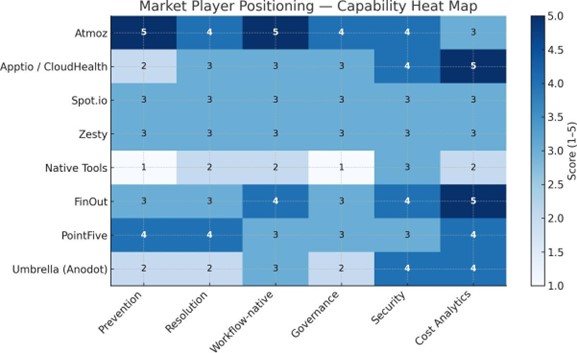
Competitive Lens (1–5; weighted)
Weights: Waste Prevention 25% · Resolution 15% · Workffow-native 15% · Governance 20% · Security 10% · Cost analytics 15%
Why it matters:
Waste Prevention: stop waste before it bills · Resolution: detection needs fast fixes · Workffow-native: approvals where teams work · Governance: auditable exceptions · Security: infra changes must meet the bar · Cost analytics: leaders fund what they can measure
Scoring notes
Atmoz
Proactive and preventive vs. dashboards: Positions around prevent-before-you-pay (detect → nudge → one-click fix → audit) rather than heavy BI that is geared towards executives that cannot make the actual change themselves. Atmoz also has Azure Marketplace offer.
Implication for scoring: High on Prevention/Resolution/Workflow-native; Strong Cost Analytics available live right where developers work.
Apptio Cloudability (IBM Apptio)
Cost visibility & allocation depth: Emphasizes multi-cloud showback/chargeback, business mappings and forecasting—classic Inform strengths.
Governance & policies: Policy-driven optimization and FinOps framework alignment; strong enterprise posture.
Implication: High-Cost Analytics and Governance; Prevention/Resolution depend on how far policy actions are automated – but all are by definition post-billing, and cannot prevent, only alert after the fact.
VMware Tanzu CloudHealth
Multi-cloud FinOps with policy engine: Perspectives, policy automation (limited to opening tickets and notifications), budgeting/forecasting; broad enterprise footprint.
Recent AI assist: Adding an AI co-pilot for cost intelligence (signals renewed product velocity).
Implication: Strong Governance/Analytics; Prevention/Resolution still more advisory/policy-led than in-workflow fixes and are post-billing.
Spot.io
Automation at the infrastructure layer: Ocean/Elastigroup automate placement & lifecycle (spot/on- demand) to cut compute spend; case studies cite 50–95% savings on compute elastigroup workloads.
Multi-cloud support (incl. Azure Spot VMs) via marketplace offers.
Implication: Solid Resolution/Prevention (at the infrastructure automation layer) for compute efficiency; less depth in Cost Analytics/allocations.
Zesty
ML-driven commitment automation: Commitment Manager auto-adjusts Savings Plans/RIs; broader features cover spot protection & K8s optimization.
Implication: Strong on rate optimization & coverage (Prevention via financial levers); mid-on Governance/Workflow-native beyond its lanes.
“Native tools” (e.g., AWS Cost Explorer/Budgets/Compute Optimizer)
Visibility & budgeting built-in: Cost Explorer/Budgets/Forecasting and rightsizing recommendations cover basics.
Limitation: Tooling tends to be reactive and console-centric; orchestration/adoption across teams is manual.
Implication: Baseline Analytics; lower Workflow-native/Prevention unless heavily scripted.
Finout
Unit economics & allocation: Strong messaging and features for per-customer/service costs and allocation (even “no-tag” mapping options).
Implication: Top-tier Cost Analytics; Resolution/Prevention rely on handing fixes to engineering or pairing with automation tools.
PointFive
Engineer-centric cost posture: Markets CEPM with team ownership, attribution and “Deep Waste” detection; emphasizes engaging engineers vs. dashboards.
Implication: Promising Workflow-native and Resolution direction; Governance depth and cross-cloud parity still maturing. Still, based on billing data and not just metrics, so prevention is limited. Only sell to with big customers, because it takes a long time to implement, and they charge percentage of the cloud bill.
Umbrella (Anodot)
AI/Anomaly heritage + new FinOps unit: Umbrella BU focuses on AI-driven FinOps; Anodot highlights unit-economics reporting.
Implication: Strong Analytics/Anomaly; fewer publicly documented in-workflow fixes today. Based on billing data, so prevention is limited.
Outcomes ROS
15–20% waste reduction in 30 days; typically, 3–5× benefit-to-fee within ~90 days with in-workflow adoption (fees tied to realized savings).
Management time reclaimed: No “cost-policing” cycles; more strategic engineering focus.
Regulatory lift: Link financial efficiency to CO₂ and disclosure requirements (CSRD/SEC/MAS).
Platform considers reservations/savings plans/discounts when calculating impact (analytics hygiene).
Buyer’s Checklist (What to Validate)
Estate coverage: Confirm AWS/GCP timelines and feature parity if multi-cloud is a must-have.
Change readiness: Ensure product owners and platform leads are prepared for in-workflow guardrails (not just monthly reviews).
Security model: Validate read-only integration scope, key management, and SSO/RBAC mapping to enterprise policies.
Governance depth: Test auto-ownership, audit trail completeness, and policy-as-code roadmap against your controls library.
Cost analytics fit — Good for attribution/verification of savings; for deep BI/allocations consider pairing with a dedicated FinOps analytics stack.
Analyst Point of View
Atmoz is a credible innovator, reframing FinOps from dashboards and reports to guardrails embedded where engineers work. Its strongest differentiation is behavioural change at source—contextual nudges, one-click fixes, ownership, and auditability—which is why short-cycle outcomes look compelling, especially for Azure-forward and AI/ML-heavy estates. To cement leadership in prevention-first FinOps, Atmoz should accelerate multi-cloud delivery and build a deeper bench of large, referenceable enterprises—momentum we’ll track.
About IHR Insights
IHR Insights is an independent research and advisory firm delivering market intelligence, custom research, and go-to-market consulting across ICT/Cloud, Data & AI, Security/Telecom, GCC and Healthcare. Beyond vendor/product evaluations, we run primary & secondary research, competitive/benchmark studies, opportunity assessment & market entry, and executive content development (CXO reports, buyer guides). Our publications stay vendor-neutral and evidence-based—grounded in live product walk-throughs, reference checks, and scenario testing—so leaders can move from slideware to measurable outcomes with clear fit, value, and risk signals. www.ihrinsights.com
Independent research provided “as is”; no warranties or liability. No endorsement or professional advice. Findings may change without notice.
Disclaimer & Limitation of Liability. This report is independent, vendor-neutral research and is provided “as is,” for informational purposes only. IHR Insights makes no warranties (including accuracy, completeness, timeliness, merchantability, fitness, or non-infringement) and disclaims liability, to the maximum extent permitted by law, for any loss or damages arising from use of or reliance on this report. No endorsement or professional advice is implied. Findings reflect IHR Insight’s opinions as of the publication date and may change without notice; no duty to update is assumed.
Corrections. If you believe this report contains a factual error or uses your IP beyond fair use, email sreeni@ihrinsights.com with supporting evidence; we will review and, if substantiated, issue a correction or takedown within 10 business days.