COOLECT (ESG REPORTING FOR MSMES)
This spotlight distils how Coolect fits the ESG-reporting landscape for MSMEs, highlighting where it wins today, what buyers must validate, and what execution steps will unlock scale across UAE, EU, and priority global corridors.
IHR INSIGHTS – DECISION SPOTLIGHT: COOLECT (ESG REPORTING FOR MSMES)
EXECUTIVE SUMMARY:
This spotlight distils how Coolect fits the ESG-reporting landscape for MSMEs, highlighting where it wins today, what buyers must validate, and what execution steps will unlock scale across UAE, EU, and priority global corridors.
Why ESG reporting is now a critical requirement
Disclosure is no longer optional: listed entities face formal guidance, investors price transparency, and supply-chain obligations extend requirements to SMEs—making assurance-ready, standards-aligned reporting an operational must.
· It’s mandated for many UAE issuers. Public joint-stock companies listed on ADX/DFM must publish an annual sustainability/ESG report, guided by the SCA’s framework and the exchanges’ disclosure guidance (31 core indicators). This has moved ESG from “nice-to-have” to a regulated disclosure stream.
· Supervisory bodies are tightening expectations. ADGM (FSRA) issued its ESG Disclosures Guidance (Aug-2025), and DFSA (DIFC) continues to set expectations around sustainable finance and climate-related disclosure—raising the bar on quality and comparability.
· Investors are pricing ESG into risk C access to capital. Global institutional investors increasingly view high-quality ESG reporting as a marker of resilience and long-term positioning; better disclosure expands the investor pool and can lower cost of capital.
· Supply-chain and non-UAE obligations are real. EU CSRD directly captures EU-listed firms and— importantly—certain non-EU groups above €150m EU turnover (plus EU branch/subsidiary thresholds), which cascades data requests down to suppliers worldwide (including UAE).
· Convergence toward ISSB. The Middle East is moving toward ISSB S1/S2 as a baseline (e.g., Qatar’s announced path), so UAE firms engaging regionally/globally will increasingly be asked for ISSB- aligned metrics.
Bottom line: Reporting is needed to comply, access finance and tenders, and remain in EU-linked supply chains—and the quality bar (assurance-ready, standard-aligned) continues to rise.
Company Snapshot:
A quick orientation to who Coolect serves, how it differentiates, the geographies it targets, and the commercial/pricing posture buyers can expect.
Name: Coolect
What it is:
Coolect is an AI-assisted ESG reporting platform built for micro, small and medium enterprises. It automates data collection, guides users through material topics, and generates standards-aligned disclosures without enterprise overhead.
Stage: Early challenger (product live; localization/assurance build-out underway)
Primary ICP:
· Micro/Small (10–249 emp) and selective Mid-market suppliers into EU/UAE-listed enterprises
· UAE ADX/DFM/ADGM/DIFC registrants needing a first credible ESG report
· Geographies (near-term): EU (incl. non-EU suppliers), UAE/GCC; next: India, South Africa, targeted North America
· Positioning statement: “From zero to an auditor-credible ESG report in ≤8 weeks—without enterprise overhead.”
· Commercial model: SaaS tiers (entity/feature based) with optional add-ons (supplier outreach, assurance pack); partner rebates for auditors/advisors
· Trust & security (current/target): SSO/RBAC, audit logs (live); SOC 2 Type I/ISO 27001 (planned), regional data-residency options (UAE/EU)
· Differentiators: MSMEs-first UX, rapid time-to-first-report, light integrations, localization runway (Arabic/RTL; UAE MRV-ready exports), assurance-friendly evidence pack
· Competitive set: Greenly, Sustain.Life (SMB); Plan A, Normative, Novisto (mid); Watershed (enterprise); Diginex (GCC supply-chain)
Offering Overview:
What the platform actually does—today and on the near-term roadmap—so buyers can map capabilities to their data reality, assurance needs, and reporting deadlines.
Core modules (today)
· Data Capture & Quality Checks
Guided questionnaires, evidence attachments, CSV/API imports (finance/utilities/HR). Data quality flags and assumptions register.
· Standards Mapping (CSRD / ISSB)
Item-by-item mapping to core disclosures; templates and guided prompts for narrative sections.
· AI-Assisted Drafting
Draft sections with inline citations to underlying data/evidence; human-in-the-loop review.
· Reporting & Exports
Branded PDF/Word exports; auditor-friendly structure with appended evidence index and change log.
In-flight / Roadmap (next 1–2 quarters)
· Double Materiality Workflow
Stakeholder C financial lenses, defensible scoring, rationale fields; heatmap output and traceability to disclosures.
· Assurance Pack
Immutable evidence register, sign-offs, version history; auditor-locked export profiles accepted by named firms.
· Localization & GCC Readiness
Arabic/RTL UI, bilingual report outputs; UAE National MRV-ready factors/units/schema; GCC regulatory mapping (UAE/KSA/Qatar) and sector presets (real estate, logistics, hospitality).
· Supplier Outreach
Consent-aware surveys, rate-limit controls, bounce handling; roll-up analytics across vendors.
Typical workflows (MSMES → first report in ≤8 weeks)
1. Kickoff & scoping (Week 0–1): select framework(s), set KPIs, define entity boundary.
2. Data ingest (Week 1–3): connect finance/utilities/HR, import prior-year baselines, capture evidence.
3. Materiality & gaps (Week 3–5): run double-materiality, assign owners, close gaps with guided tasks.
4. Draft & review (Week 5–7): AI-assisted narrative, internal reviews, board/Audit Committee sign- offs.
5. Assurance & publish (Week 7–8): export assurance pack, remediate comments, publish final.
Integrations (pragmatic set)
· Finance/ERP: CSV + QuickBooks/Xero (light), SAP/Oracle (CSV templates)
· Utilities & meters: Bill OCR/CSV; IoT CSV
· HRIS: CSV import; API roadmap for common systems
Outputs & formats
· Reports: PDF/Word (EN; EN/AR on roadmap), auditor-locked export; MRV-ready export profile (UAE)
· Data: CSV/JSON exports of all tables, mappings, and evidences (open-data stance)
Value proof (what buyers should expect)
· Time-to-first-report: ≤8 weeks from kick-off
· Data coverage: ≥85% of planned datapoints populated with primary/high-quality secondary data
· Assurance delta: ≤10% adjustments post-audit (first cycle)
Proof-points & credibility plan
· Next G0–120 days: 6–10 auditor-accepted references across EU/UAE/India/SA; publish
Arabic/RTL, MRV-ready exports; announce 2–3 assurance partners; SOC 2 Type I in motion.
Why now
Converging standards and regional initiatives are elevating expectations; this section explains the market timing that makes a lightweight, audit-credible MSMEs solution relevant.
Regulators and markets are converging on global baselines (ISSB S1/S2), while the EU’s CSRD expands disclosure and UAE authorities tighten sustainability reporting expectations. SMEs—often suppliers to listed firms—need credible, lightweight, affordable tooling.
UAE National MRV System — What it is & why it matters
A brief on what the MRV initiative is (and isn’t) and how its conventions will shape factors, formats, and assurance expectations for corporate reporters over time.
· During GITEX Global 2025, the UAE launched a National MRV (Measurement, Reporting & Verification) system—a first-of-its-kind integrated national platform combining greenhouse-gas emissions and air-pollutant monitoring. The goal: a reliable, unified database for evidence-based policy and tracking progress toward Net Zero 2050.
· Media briefings emphasize faster national inventories (from ~15 months to ~3 months) and stronger climate-governance.
· The announcement sits alongside other GITEX sustainability/tech initiatives (e.g., MoCCAE–IBM collaboration on AI for environmental use-cases; Abu Dhabi DoE’s AD.WE power platform roadmap), reinforcing a wider “data+AI for sustainability” push.
What it is not (so far): a full corporate ESG filing portal. It’s a government platform for national-level monitoring and reporting, but it will likely influence corporate data formats, factors, and expectations over time.
SCOT ANALYSIS (UAE & GLOBAL)
A pragmatic view of strengths, challenges, opportunities, and threats—first in UAE (ADX/DFM/ADGM/DFSA context), then globally—so leaders can anticipate execution risks and tailwinds.
UAE (ADX/DFM onshore + ADGM/DIFC free zones)
Strengths
· Clear SME focus and automation narrative (data collection + AI drafting) lowers reporting friction for budget-constrained firms.
· “Alignment to latest standards” positioning fits UAE’s move toward IFRS/ISSB baseline and convergence with global frameworks.
Challenges
· Many UAE SMEs still perceive ESG as “nice-to-have”; education + change mgmt. needed.
· Must localize: Arabic UI, UAE sector templates (real estate, logistics, retail, family conglomerates), and ADGM/DFSA guidance mapping.
· Competes not only with software, but Big-4/consultancies bundling tooling + assurance.
· Launch of National MRV System in UAE – (Likely near-term effects)
o Standardization pressure. The MRV will normalize emission factors, sector codes, and boundaries used in national inventories. Expect buyers and auditors to prefer tools that map to MRV conventions out of the box.
o Data-exchange expectations. Government platforms often mature toward APIs or upload templates. Vendors that can export MRV-ready files (and, later, automate submissions) will gain credibility and reduce year-end friction. (Inference based on typical evolution of national MRV platforms.)
o Rising bar for assurance-readiness. With faster national inventories, auditors will expect traceable corporate data (evidence registers, versioning, audit trails), increasing demand for assurance-grade workflows in vendor tools.
o Education shifts from “why” to “how.” As the state narrative centers on Net Zero, board conversations shift to procedural quality (double materiality, governance, controls) rather than whether to report.
Opportunities
· Mandatory sustainability reporting for UAE listed issuers and growing guidance in free zones → demand for simpler tools and audit-ready exports.
· Assurance partnerships (local audit/advisory firms) to de-risk and accelerate adoption.
· Supply-chain pull: UAE SMEs selling into EU buyers under CSRD pressure.
· Launch of National MRV System in UAE – (Strategic opportunities for Coolect)
o Be the “SME front-end” to the MRV. Ship MRV-ready exports (schema, factors, units) and publicize “Built for UAE MRV” positioning. This turns a gov platform into a go-to-market accelerant for thousands of SMEs who won’t build internal tooling.
o Local emission-factor packs. Bundle UAE grid / sector factors and Arabic/RTL reports so outputs slot neatly into MRV/ADX/ADGM/DFSA expectations.
o Assurance partnerships. Co-design auditor-accepted exports tied to MRV conventions; announce 1–2 UAE audit partners to de-risk buyer decisions.
o Bridge to EU workflows. Pair MRV-aligned GHG with CSRD/ISSB mappings so UAE exporters can satisfy UAE + EU asks in one pass
Threats
· Global vendors (Watershed, Plan A, Greenly, Diginex, Normative, Novisto, Sustain.Life) pursuing the region via partners; several already tout CSRD/ISSB.
· Regulatory fluidity (e.g., SEC climate rule pause/rollbacks) can confuse buyers and stall budgets.
· Launch of National MRV System in UAE – (Risks if Coolect waits)
o Feature parity risk: Global vendors will quickly claim “MRV-ready” and out-message on compliance credibility.
o Commoditization at the low end: If the state eventually offers a basic free uploader, SMBs may default to it—leaving value in workflow, integrations, and assurance (where Coolect must excel). (Forward-looking inference grounded in how gov portals often evolve.)
o Integration gap: Without early alignment, year-end handoffs become manual, hurting NPS and renewal rates.
Global
Strengths
· “MSMEs first” wedge remains underserved in a market overweighted to enterprise features.
· AI assistance for data capture C report drafting is a strong ROI story for small teams. Challenges
· Credibility moat: buyers ask for assurance readiness, double materiality, framework mapping (CSRD/ESRS, GRI, ISSB, sector KPIs).
· Need integrations (accounting/HRIS/utilities) for true automation. Opportunities
· EU leads with CSRD/ESRS; listed SMEs phase in and supply chains feel the squeeze; VSME (voluntary SME standard) is emerging to simplify.
· ISSB S1/S2 adoption momentum beyond EU (e.g., Qatar C Jordan timelines announced).
Threats
· Rapid standard shifts (e.g., ISO–GHG Protocol alignment) require constant product updates.
· Consolidation: vendors partner with assurance majors (e.g., SGS × Diginex) to lock in accounts.
What it does (today)
· Centralizes ESG data collection (questionnaires, evidence, basic integrations)
· Produces audience-ready reports mapped to leading standards (claims)
· AI assistance to draft sections and flag gaps
(Road mapped: double-materiality workffows, assurance exports, Arabic localization)
PRODUCT–MARKET FIT (PMF): WHERE COOLECT MAKES SENSE NOW
Who feels the pain most, what jobs-to-be-done the product solves, and the conditions under which fit strengthens or weakens.
Ideal customer profiles (UAE)
· ADX/DFM-listed SMEs needing structured ESG reports within 90 days of FY-end.
· ADGM/DIFC-registered entities close to disclosure thresholds wanting ISSB-aligned light-weight tooling.
· Export-oriented SMEs selling into the EU or to MNCs that cascade CSRD requests to suppliers.
Ideal customer profiles (Global)
· EU listed SMEs and non-EU SMEs in EU supply chains seeking CSRD-ready reporting without enterprise complexity.
Core JTBDs (jobs-to-be-done)
1. Gather ESG data with minimal manual effort
2. Run double-materiality and produce assurance-ready reports
3. Map to CSRD/ESRS / ISSB and export to auditor templates
4. Guide teams on “what good looks like” with benchmarks and nudges
Signals of PMF risk/fit
· Fit strengthens if Coolect offers Arabic, GCC mapping, and partnered assurance; weakens if those are absent.
DIFFERENTIATORS
· MSMEs-first UX C pricing (vs. enterprise-heavy suites)
· Speed to a publishable report vs. multi-month implementation
· Localization runway for Arabic/GCC mappings
REPRESENTATIVE USE CASES
1. UAE SME supplying EU retailers → CSRD-ready supplier pack with evidence attachments.
2. ADGM entity approaching disclosure thresholds → ISSB-aligned report + auditor export.
3. Family conglomerate subsidiary → baseline report + board KPI dashboard.
COMPETITIVE LENS (SELECTED PEERS)
Where Coolect sits relative to SMB and enterprise-grade peers—what others do better today, and where a challenger edge can emerge.
Vendor | SMB focus | CSRD/ISSB story | Notable edges vs Coolect (today) |
Greenly | Strong SMB motion with transparent pricing | CSRD modules; templates | Large SMB base, content engine, app marketplace. |
Plan A | Mid-market up | Robust CSRD, TÜV- certified methodology | Deep decarbonization suite + audits/assurance partners. |
Watershed | Enterprise first | Dedicated CSRD product | Powerful automation, reduction marketplace, enterprise logos. |
Normative | SMB → mid | Carbon engine + compliance | Mature content/legislation tracker; services layer. |
Diginex | Asia/GCC reach | Multi-framework ESG + supply chain | Strong SGS partnership, human- rights/supply-chain depth. |
Novisto | Mid/enterprise | ESG data mgmt; CSRD | Data governance strength; enterprise integrations. |
SMB | Carbon + reporting | Practical SMB packaging and content. |
Coolect’s challenger angle: Win MSMEs speed + localization (Arabic/GCC), assurance-ready exports, and partner motion in UAE/EU corridors.
HEAT MAPS:
Scoring notes (applies to all heatmaps)
Scale.
· 2 = Present C evidenced: publicly documented features/modules, live demos in blank tenants, named assurance partners, or formal certifications/whitepapers.
· 1 = Partial / claimed: marketing claims without full evidence, or capability present but narrow (e.g., basic templates, manual exports, or pilot-only).
· 0 = Not stated: capability not communicated or not observable; we default to 0 rather than assume.
Method.
· Consolidated from your pitch intent plus public vendor materials. Where your internal MARKET PLAYER POSITIONING uses different criteria, we can re-score 1:1 and regenerate charts.
Caveats.
· Scores are directional, not absolute. Vendors evolve quickly; regional/localization claims are validated only when we can see reports, screenshots, or auditor acceptances.
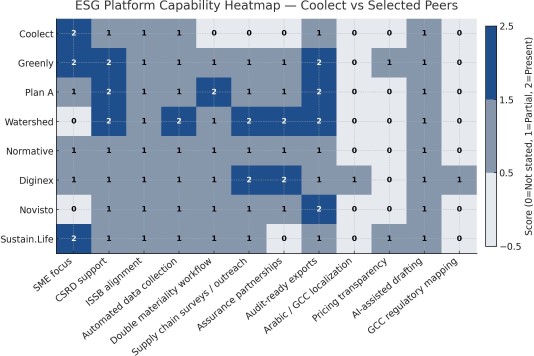
ESG PLATFORM CAPABILITY HEATMAP — COOLECT VS SELECTED PEERS
Use this to see feature breadth at a glance across standards mapping, automation, assurance-readiness, and localization—scored conservatively (0/1/2) to focus discussion on gaps that matter.
Opinions & Methodology. Capability scores, heat maps, and competitive characterizations are opinions based on our methodology, assumptions, and vendor/public materials as of October 2025; they are directional, not statements of fact, and not a substitute for buyer testing or RFPs. Vendors may submit factual corrections with evidence at the contact listed herein.
What the chart shows
· Rows: Vendors.
· Columns: Common buyer criteria across ESG platforms.
· Scores: 0 = Not stated, 1 = Partial / claimed, 2 = Present C evidenced
Scoring Notes
Coolect:
· Strong “SME focus (2)” with basic CSRD (1), ISSB (1) and automated data capture (1); AI-assisted drafting (1) is emerging. Gaps vs. buyer expectations are double materiality (0), supply-chain outreach (0), assurance partnerships (0), Arabic/GCC localization (0), GCC regulatory mapping (0).
Implication: To be audit-credible in UAE/EU corridors, fast-track double materiality, assurance-ready exports, and Arabic/GCC.
Greenly:
· Broad SMB coverage with meaningful CSRD (2) and audit-ready exports (2); clear go-to-market for small companies.
Plan A:
· Strong CSRD (2) and double materiality (2); good reporting depth for mid-market.
Watershed:
· High automation and assurance partnerships (2/2) drive enterprise appeal; lighter for SMB pricing transparency.
Normative:
· Consistent 1s across the board — a safe mid-tier baseline; less region-specific depth.
Diginex:
· Stands out on audit-ready exports (2) and assurance partnerships (2); has relevant Arabic/GCC (1) + GCC mapping (1).
Novisto:
· Data governance-first posture; strong reporting baseline but lighter on SMB packaging.
· Clear SMB posture; practical playbook and pricing clarity; less deep on enterprise controls
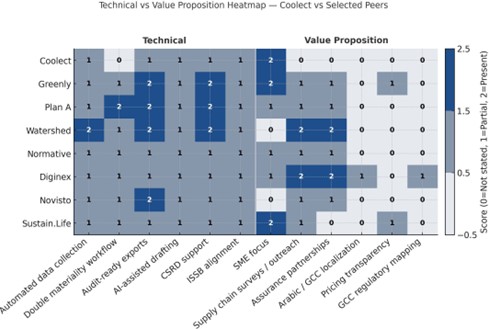
TECHNICAL VS VALUE PROPOSITION HEATMAP — COOLECT VS SELECTED PEERS
This split view separates “can the platform do it?” from “is it packaged for my context?”, surfacing where technical depth or go-to-market proof points must improve.
Opinions & Methodology. Capability scores, heat maps, and competitive characterizations are opinions based on our methodology, assumptions, and vendor/public materials as of October 2025; they are directional, not statements of fact, and not a substitute for buyer testing or RFPs. Vendors may submit factual corrections with evidence at the contact listed herein.
What the chart shows
· Left block (Technical): data capture, double materiality, audit/export rigor, AI drafting, CSRD/ISSB support.
· Right block (Value Proposition): who it’s built for (SMB vs enterprise), supplier outreach, assurance ecosystem, localization, pricing clarity, GCC mapping.
· Scores: 0/1/2 as above.
Scoring Notes
Coolect:
· Technical: solids at 1s (automation, CSRD/ISSB, AI drafting). Double materiality is 0 — the main blocker for assurance-ready reporting.
· Value prop: SME focus (2) is clear; everything else is still 0 (supplier outreach, assurance partners, Arabic/GCC, pricing clarity, GCC mapping).
· Implication: The product story is coherent for SMBs, but proof of rigor + localization must be visible to win regulated or EU-linked firms.
Watershed:
· Highest technical depth (multiple 2s) but neutral SMB value extras; targeted at enterprise programs.
Plan A / Greenly:
· Balanced — credible technical and practical value for SMB–mid. Greenly strongest on SMB packaging.
Diginex:
· Value-side standout (assurance partnerships (2), supplier outreach (2), Arabic/GCC (1), GCC mapping (1)), useful for GCC supply-chain work.
Normative / Novisto:
· Middle-lane reliability; fewer spikes on either side.
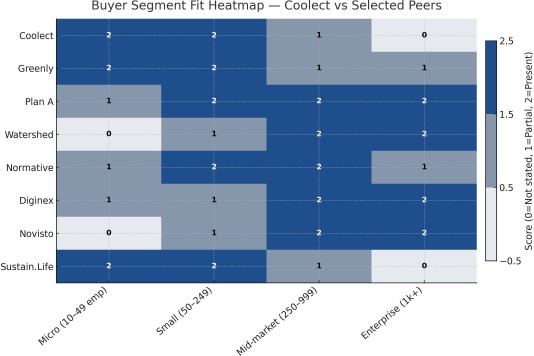
BUYER SEGMENT FIT HEATMAP — COOLECT VS SELECTED PEERS
A reality check on which company sizes get the best experience today, and where additional integrations, assurance, or services are required to raise fit.
Opinions & Methodology. Capability scores, heat maps, and competitive characterizations are opinions based on our methodology, assumptions, and vendor/public materials as of October 2025; they are directional, not statements of fact, and not a substitute for buyer testing or RFPs. Vendors may submit factual corrections with evidence at the contact listed herein.
What the chart shows
· Columns: Company size segments.
· Scores: 0/1/2 indicate relative fit and commercial packaging for each segment.
Readouts C takeaways
Coolect:
· Ideal for Micro and Small (2/2). Mid-market (1) is reachable with assurance + integrations; Enterprise (0) is intentionally not the target today.
Greenly / Sustain.Life:
· Strongest for Micro/Small, with some Mid traction (Greenly shows 1 at Enterprise).
Plan A:
· Mid and Enterprise ready (2/2); credible for larger programs.
Watershed / Novisto / Diginex:
· Mid–Enterprise strengths (2s), reflecting depth and services.
Normative:
· Good Small–Mid balance; some Enterprise reach through services.
BUYER’S CHECKLIST (WHAT TO VALIDATE)
Turnkey due diligence prompts and acceptance criteria that convert marketing claims into verifiable deliverables and contract terms.
Choose Coolect when…
· You’re a UAE/EU-exposed MSMEs needing a credible first or catch-up ESG report fast.
· You want auditor-friendly structure without enterprise complexity/cost.
· You need localization (Arabic/RTL, UAE MRV-ready) and plan to grow features over time.
Consider alternatives when…
· You’re an enterprise with deep decarbonization programs, marketplace procurement, and dozens of integrations (Watershed/Plan A fit better).
· You require heavy GRC consolidation or highly customized data governance (Novisto/enterprise suites).
Here’s a practical checklist you are considering an ESG tool. It’s organized so a buyer (CFO/CSO/Compliance) can turn each caution into a due-diligence question and acceptance criterion.
1) Regulation & Assurance (most critical)
· Exact framework fit, not just “aligned.”
Ask: Which version of CSRD/ESRS or ISSB S1/S2 is implemented? Which ESRS datapoints are fully supported vs. approximated vs. not supported? Show a coverage matrix. Accept only if: They provide a traceable mapping table and release notes when standards change.
· Double materiality depth.
Ask: Does the workflow include stakeholder lens, financial impact lens, and risk/opportunity scoring with thresholds and rationale fields? How do they handle “omitted but material” disclosures?
Pitfall: Cosmetic surveys without defensible scoring logic.
· Assurance readiness.
Ask: Is there an evidence register, version control, sign-offs, timestamps, and non-editable audit trails? Can they export an assurance pack accepted by named audit firms? Red ffag: “We’re not an assurance tool” with no export structure.
· Local regulator nuances.
UAE buyers: Confirm mappings for ADX/SCA guidance, ADGM and DFSA expectations; bilingual Arabic/English report support and local currency/units.
2) Methodology & Coverage
· Emission factors & data quality.
Ask: Which sources (e.g., GHG Protocol, national grid factors) and update cadence? How do they treat UAE/GCC grid intensity and water metrics? Do they show data quality scores and assumptions?
· Scope 3 depth.
Ask: Do they support activity-based methods beyond spend-based estimates? Product carbon footprint (PCF) options?
· Estimation & gaps.
Ask: How are missing data imputed and flagged? Can you override with primary data and lock it?
3) Data, Integrations & Supplier Outreach
· Core integrations.
Ask: Native connectors for accounting (Xero/QuickBooks/SAP), HRIS/payroll, utilities, basic IoT or CSV imports? API rate limits?
Caution: Manual CSV-only = hidden ops burden.
· Supplier surveys.
Ask: Is there a supplier portal, throttling, bounce handling, consent capture, and GDPR/UAE anti- spam compliance?
Red ffag: Spray-and-pray emails that harm supplier relationships.
4) AI Use (drafting & insight)
· Human-in-the-loop.
Ask: Can AI-generated text be flagged and reviewed before publishing?
· Data privacy with GenAI.
Ask: Are your prompts/content used to train external models? Can you disable AI or confine it to vendor-managed models?
· Hallucination guardrails.
Ask: Does the product cite sources for claims and restrict AI from inventing metrics?
5) Localization for UAE & GCC
· Arabic & RTL.
Ask: Is the UI and exported report fully RTL with Arabic labels and correct numerals/date formats?
· GCC regulatory mapping.
Ask: Templates for UAE real estate, logistics, retail, hospitality; KSA/Qatar/Jordan ISSB trajectories; local water/stress and energy norms.
6) Security, Privacy & Trust
· Certifications & controls.
Ask: SOC 2/ISO 27001 status, last pen test, encryption at rest/in transit, SSO (SAML/OIDC), RBAC, IP allow-listing.
· Data residency & sub processors.
Ask: Where is data stored (UAE/EU options)? List of sub processors, breach notification SLA, RPO/RTO.
· Privacy law coverage.
Ask: Support for GDPR, DIFC Data Protection Law, user deletion/retention policies.
7) Product Maturity & Roadmap Risk
· What’s shipping vs. promised.
Ask: A capability matrix with dates; demo in a blank tenant (not a curated demo).
· Release discipline.
Ask: Access to changelog, rollback policy, SLA for regulatory updates (e.g., new ESRS interpretations).
· Scalability limits.
Ask: Max entities, users, rows; report generation time; supplier survey volumes per day; attachment storage caps.
8) Implementation, Change Management & Support
· Project plan & roles.
Ask: A 6–10-week plan with RACI, data owners, and acceptance criteria (e.g., % data coverage, assurance pass rate).
· Enablement.
Ask: Admin/author training, playbooks for first report and year-on-year updates.
· Support model.
Ask: Time zone coverage, weekend support, ticket SLA, named CSM, escalation path.
9) Contracting & Pricing (avoid gotchas)
· Metric of charge.
Ask: Is pricing per entity, per report, user seats, supplier invites, storage, or assurance pack? Define overages and fair-use.
· Renewal uplifts & exit.
Ask: Cap renewal % increase; include data export rights (all raw + mappings), schema docs, and transition assistance.
· Professional services.
Ask: What’s included vs. billed (materiality workshops, data cleaning, Arabic translations, auditor liaison)?
10) Interoperability & Lock-In
· Open exports.
Ask: Can you export all data + evidence to CSV/JSON, and reports to Word/PDF/XBRL (where applicable)?
· Framework portability.
Ask: If you switch vendors, can Coolect export mappings so you don’t redo year-one work?
11) Governance & Ethics
· Greenwashing risk controls.
Ask: Are assumptions clearly labelled, with variance explanations and review signoffs?
· Board governance.
Ask: Built-in review gates for Audit/Board and a record of approvals.
· Segregation of duties.
Ask: Can you separate data entry, reviewer, and approver roles?
12) Business Continuity
· Contingency.
Ask: Backups, disaster recovery (RPO/RTO), vendor escrow/continuity plan, and an offline export you control.
UAE-specific cautions (on top of the above)
· Arabic reporting is not a cosmetic ask. Ensure true RTL support and bilingual output that your Board and regulator will accept.
· Local expectations evolve. Get a contractual update SLA for ADX/SCA, ADGM, DFSA changes.
· Data residency for government-linked or regulated entities. Confirm UAE or GCC hosting options and cross-border transfer terms.
· Sector presets. Demand UAE-relevant templates (real estate intensity, logistics scope-3, hospitality water metrics).
· Supplier outreach etiquette. Ensure consent, branded emails, and rate limits to avoid deliverability or compliance issues.
Region-Ready Checklists (what buyers should demand)
Regional must-haves (North America, India, South Africa, Everywhere) so teams can localize scope, templates, and assurance pathways upfront.
· North America: California-aligned emissions C risk outputs; SOC2, SSO/RBAC; open exports; 2 local assurance partners.
· India: BRSR/BRSR-Core templates + assurance pathway; multi-entity roll-ups; INR pricing; named Big-4/boutique auditor acceptance.
· Africa (SA first): JSE/King-aligned disclosures; strong evidence register; water C scope-3 presets; CSV/offline resilience.
· Everywhere: Double materiality in-product; supplier outreach with consent tracking; auditor- locked exports; data residency options.
Red-ffag patterns to watch
Common failure modes that correlate with rework, audit friction, or poor renewals—use these to pressure- test vendor readiness.
· “Aligned to everything” with no detailed mapping table.
· AI text generation with no human review step.
· No assurance partners or examples of auditor-accepted exports.
· “We’ll ship Arabic/GCC next quarter” with no dates or design proofs.
· Pricing that looks simple until you scale supplier surveys/storage.
· Can’t export raw data + evidence in open formats.
Acceptance KPIs (tie payments to outcomes)
Measurable outcomes to embed in SOWs—time-to-first-report, data coverage, assurance deltas, localization completeness, and support SLAs.
· Time-to-first report: ≤ 6–8 weeks from kick-off.
· Data coverage: ≥ 85% of planned datapoints populated with primary or high-quality secondary data.
· Assurance delta: ≤ 10% adjustments post-audit on first cycle.
· Localization completeness: 100% bilingual output for agreed report sections.
· Support responsiveness: P1 tickets ≤ 4 business hours to engage; ≤ 2 business days to resolve/work-around.
RISKS & MITIGATIONS
Known execution risks and the specific countermoves (partners, packs, process) that reduce buyer exposure.
· Assurance credibility → partner with regional auditors/certifiers; ship an assurance pack.
· Regulatory churn → publish update notes tied to CSRD/ISSB releases.
· Localization gap → prioritize Arabic + GCC guidance in Q1.
ANALYST POINT OF VIEW
Our synthesized take: where Coolect should be shortlisted, what needs to ship next, and how to interpret early wins or misses.
Coolect is a focused MSMEs ESG-reporting challenger that can convert standards complexity (CSRD/ESRS, ISSB) into fast, auditable outputs for small and mid-size firms.
The highest near-term traction remains EU + EU-linked supply chains; however, credible localization and assurance can open North America (select states/investors), APAC—especially India, and Africa (South Africa-led). The execution crux is unchanged: ship double materiality, assurance-grade evidence packs, Arabic/RTL + GCC mapping, and UAE MRV-ready exports—then replicate that “local credibility pack” in each region (e.g., India BRSR, California SB-253/261, South Africa JSE/King IV).
If Coolect lands 6–10 auditor-accepted references across these corridors, it becomes the default SMB front-end where enterprise suites are too heavy and consultancy tools too expensive.
IHR Verdict:
· Shortlist for UAE C EU-linked SMEs needing a first credible report in ≤8 weeks.
· North America: Opportunistic—lead with California coverage and investor/lender asks; federal rule flux means target mandate-exposed or large-customer-pressured SMBs.
· APAC (India focus): Promising if BRSR/BRSR-Core-ready exports and local assurance partnerships are visible; strong pull from listed-group suppliers and banks.
· Africa: Constructive watch starting with South Africa (JSE/King IV) and pan-African lender programs; win via partner-led assurance and simple, auditable workflows.
Regional Perspective (what matters and how to win)
What moves each region (regulators, investors, supply chains), who the ICPs are, and the playbook to win without over-engineering.
North America (US & Canada)
· Why it moves: State-level momentum (e.g., California SB-253/261) and investor-led requests keep disclosure pressure high even while federal rules remain in flux.
· ICP: VC-backed tech, manufacturing, food/retail suppliers to large brands; private credit portfolios asking for KPI packs.
· Must-have: California-aligned emissions C climate-risk outputs; auditor-accepted evidence; clear data residency and SOC2/ISO posture.
· GTM: Partner with regional assurance boutiques and credit funds; offer “California pack” + supplier survey add-on; publish 2–3 US references.
· Risks: Federal uncertainty → budget deferrals; depth of automation expected by NA buyers is high (integrations).
APAC (India + SE Asia)
· Why it moves: India’s BRSR/BRSR-Core for top listed firms cascades to suppliers; banks and PE increasingly request ESG data rooms.
· ICP: Mid-market suppliers to listed groups (auto/chemicals/pharma/ITeS), export-oriented MSMEs, and PE portfolios.
· Must-have: BRSR/BRSR-Core-ready exports (with limited/reasonable assurance pathway), multi- entity handling for conglomerate structures; strong CSV/API imports from accounting/ERP.
· GTM: Co-sell with Indian audit firms; price in INR tiers; provide sector presets (chemicals, pharma, auto ancillaries).
· Risks: Data quality gaps and language diversity; ensure evidence trail C sign-off governance to avoid “checkbox” perception.
Africa (South Africa-led)
· Why it moves: JSE guidance + King IV governance culture; DFIs/banks drive KPI requests; mining/industrial supply chains need auditable data.
· ICP: SA-listed mid-caps and supplier networks (mining, retail, logistics); pan-African portfolios held by DFIs/PE.
· Must-have: Assurance-friendly exports, scope-3 supplier outreach that works in low-data environments, and offline/CSV resilience.
· GTM: Partner with SA audit/cert bodies; deliver 1–2 mining/industrial case studies; add water/stewardship metrics where material.
· Risks: Connectivity and data completeness; win with pragmatic templates and evidence registers rather than flashy AI alone.
Global Confidence Triggers (Up/Down)
What evidence should move a buyer or investor from watchful to confident—by quarter, by region, and by commercial/operational signals.
Confidence ↑ (bullish if observed in next S0–120 days)
· Cross-regional references: 6–10 auditor-accepted customer reports across UAE/EU (≥3), India (≥2), and NA or SA (≥1–2) with ≤8-week TTF report and assurance delta ≤10%.
· Local credibility packs:
o UAE/GCC: Arabic/RTL + MRV-ready exports, GCC regulatory mapping.
o India: BRSR/BRSR-Core-ready templates C exports.
o North America: California emission C climate-risk outputs + SOC2 Type I.
o South Africa: JSE/King-aligned disclosures, water C just-transition notes where material.
· Commercial health: Trial → paid ≥45% in ICP; NRR ≥105% via assurance packs/supplier outreach add-ons; CAC payback ≤9 months.
· Ops & trust: Uptime ≥99.9%, P1 response ≤4 business hours; DPAs + regional data-residency options (EU/UAE/India/SA).
Confidence ↓ (bearish if observed)
· References stall by region: <2 verifiable wins per focus region after two quarters; auditor rework
>15% or rejected exports.
· Localization slips: Arabic/RTL, BRSR-Core, or California packs repeatedly deferred; missing sector presets in India/SA.
· Assurance vacuum: No named partners in UAE/India/SA; “audit-ready” claims rely on manual spreadsheets.
· Commercial stress: Heavy discounting to renew (<-20%), services margin <30%, churn >12% in Micro/Small.
· Governance gaps: Weak DPAs/residency, no pen-test cadence; supplier outreach triggers deliverability/privacy complaints.
Baseline view: Constructive / Watch (Global). Tilt up with multi-region, auditor-accepted references and region-specific credibility packs; tilt down if localization and assurance lag or if deals depend on custom services rather than productized workflows.
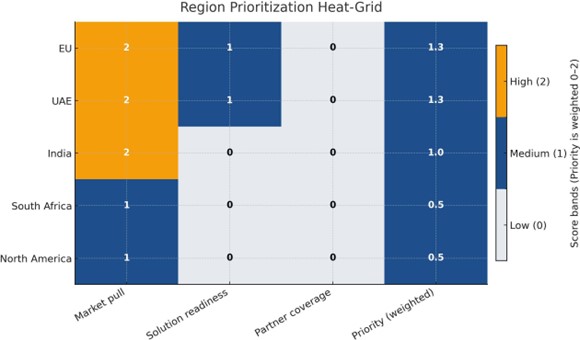
REGION PRIORITIZATION – COOLECT
A one-page sequencing tool that combines market pull, solution readiness, and partner coverage into a single “where to focus first” priority score.
Opinions & Methodology. Capability scores, heat maps, and competitive characterizations are opinions based on our methodology, assumptions, and vendor/public materials as of October 2025; they are directional, not statements of fact, and not a substitute for buyer testing or RFPs. Vendors may submit factual corrections with evidence at the contact listed herein.
How to read it (method)
· Scale: 0 = Low (Grey), 1 = Medium (Blue), 2 = High (Orange).
· Weights: Market pull 0.5, Coolect readiness 0.3, Partner coverage 0.2.
· Numbers shown: Integers for the three inputs; one decimal for Priority.
Priority (weighted) is a single score (0–2) that combines three inputs to show where to focus first:
· Market pull (0=low, 1=med, 2=high): regulatory/investor pressure + demand
· Solution readiness (0–2): how ready the product/localization is for that region
· Partner coverage (0–2): assurance/channel partners in place
Most recent scores (directional)
· EU — Priority 1.3 (2/1/0): Strongest market pull (CSRD/ESRS + assurance). Readiness is decent but not complete until double-materiality C assurance packs are production-grade. Partner slots still to be formalized.
· UAE — Priority 1.3 (2/1/0): High pull (ADX/DFM, ADGM/DFSA expectations + National MRV). Readiness climbs as Arabic/RTL + MRV-ready exports ship. Lock in two local assurance partners to flip many 0→1 decisions.
· India — Priority 1.0 (2/0/0): BRSR/BRSR-Core creates clear demand; priority rises fast with BRSR- ready exports and Indian assurance partners.
· South Africa — Priority 0.5 (1/0/0): JSE/King IV + DFI pressure = steady pull. Win with assurance- friendly evidence packs, water/stewardship presets, CSV/offline resilience.
· North America — Priority 0.5 (1/0/0): State-led (e.g., California) and investor asks to create targeted pull. Anchor with a California pack + SOC2 and 1–2 local references.
What would lift priorities 0.5–1.3 into the ‘go now’ zone (≥1.5)
· Readiness upgrades (0→1→2):
o Ship double materiality and assurance pack (evidence register, immutable audit trail, signoffs).
o Arabic/RTL + MRV-ready exports (UAE); BRSR/BRSR-Core-ready exports (India); California outputs (NA); JSE/King aligned pack (SA).
· Partner coverage (0→1+):
o Announce 2–3 named auditors/certifiers per region with acceptance guides and sample checklists.
o Co-market first auditor-accepted customer reports per region.
ABOUT IHR INSIGHTS
IHR Insights is an independent research and advisory firm delivering market intelligence, custom research, and go-to-market consulting across ICT/Cloud, Data & AI, Security/Telecom, GCC and Healthcare. Beyond vendor/product evaluations, we run primary & secondary research, competitive/benchmark studies, opportunity assessment & market entry, and executive content development (CXO reports, buyer guides).
Our publications stay vendor-neutral and evidence-based—grounded in live product walk-throughs, reference checks, and scenario testing—so leaders can move from slideware to measurable outcomes with clear fit, value, and risk signals. www.ihrinsights.com
Independent research provided “as is”; no warranties or liability. No endorsement or professional advice. Findings may change without notice.
Disclaimer & Limitation of Liability. This report is independent, vendor-neutral research and is provided “as is,” for informational purposes only. IHR Insights makes no warranties (including accuracy, completeness, timeliness, merchantability, fitness, or non-infringement) and disclaims liability, to the maximum extent permitted by law, for any loss or damages arising from use of or reliance on this report. No endorsement or professional advice is implied. Findings reflect IHR Insights opinions as of the publication date and may change without notice; no duty to update is assumed.
Corrections. If you believe this report contains a factual error or uses your IP beyond fair use, email sreeni@ihrinsights.com with supporting evidence; we will review and, if substantiated, issue a correction or takedown within 10 business days
Disclaimer
Purpose & non-Reliance
This report is provided for informational purposes only to assist the recipient in evaluating market dynamics and potential solutions. It does not constitute legal, financial, tax, accounting, or investment advice, and no decision should be made in reliance upon it without independent professional advice appropriate to your circumstances.
Sources, Assumptions & Accuracy
The analyses herein reffect a combination of primary materials provided by Coolect, third-party information believed to be reliable, and our own assumptions and models. We do not independently audit or verify third-party data. All information is provided “as is,” without warranties of any kind, and may be incomplete or subject to change without notice.
Forward-Looking Statements
Any statements about expected benefits, performance, timelines, market size, pricing, or adoption are forward-looking and involve known and unknown risks and uncertainties. Actual results may differ materially. We assume no obligation to update forward-looking statements.
Regulatory & Compliance
References to regulations (including telecom, privacy, data protection, recording/consent, consumer, or sector- specific rules) are general in nature and not legal advice. Applicability varies by jurisdiction and use-case. You are responsible for obtaining your own legal counsel and ensuring compliance with all applicable laws before implementation or use.
Third-Party Products & Trademarks
All third-party product names, logos, and trademarks are the property of their respective owners and are used for identification only. Inclusion does not imply endorsement, affiliation, or sponsorship.
No Offer / No Solicitation
Nothing herein constitutes an offer to sell or a solicitation to buy any product, service, security, or instrument, nor a commitment to enter into any agreement. Any engagement is subject to separate, definitive written terms agreed by the parties.
No Warranties; Limitation of Liability. This report is provided “as is” without warranties of any kind. To the maximum extent permitted by law, we (and our affiliates, officers, employees, and contractors) are not liable for any indirect, incidental, special, consequential, exemplary, or punitive damages, or for any loss of profits, revenue, data, goodwill, or business interruption, arising from or related to this report or reliance on it, even if advised of the possibility of such damages. Our aggregate liability for any claim relating to this report shall not exceed USD 500 or the amount paid for access in the 12 months before the claim, whichever is greater. This clause does not limit liability for fraud or for death or personal injury to the extent such limitation is not permitted by law.
No Reliance; Independent Compliance. You acknowledge that you alone are responsible for legal, regulatory, telecom, and privacy compliance (including consent/recording, DNC/TCPA/PDPL/PECR-style regimes, data export, and sector rules). You agree not to rely on this report as legal advice and to obtain independent counsel before implementation.
License & Restrictions. We grant a limited, non-transferable license to access this report for your internal evaluation only. You may not reproduce, distribute, or create derivatives without our written consent. Access or download constitutes acceptance of these terms.
Attribution. Roadmaps, pricing, performance targets, SLAs, and compliance postures referenced herein are as represented by the named vendor(s) at the time of drafting and were not independently audited by us.
Severability. If any provision of these terms is found unenforceable, the remaining provisions will remain in full force and effect.
Confidentiality & Distribution
This report is intended solely for the addressee’s internal use and may contain confidential information. Do not distribute, reproduce, or disclose without our prior written consent. If you are not the intended recipient, please notify us and delete all copies.
No Endorsement. Inclusion of any vendor or competitor does not constitute endorsement; trademarks belong to their owners. Our findings reffect our independent judgment as of the date of publication and may change without notice.
Prepared by: IHR Insights • Report: Vendor Spotlight • Date: October 2025 • Contact: sreeni@ihrinsights.com