TaskFino “Run people, money, and customers from one compliant, AI-assisted system.”
AI-powered single platform to run HRMS, Payroll, CRM, Accounting, Assets, Tasks, and Loan workflows with regional compliance.
IHR INSIGHTS – DECISION SPOTLIGHT: TaskFino
EXECUTIVE SUMMARY
SMB and mid-market leaders are running on 7–12 disconnected systems while regulatory load (VAT/WPS/GST/Corporate Tax), board oversight, and cash discipline tighten. This tool sprawl slows the close, muddies compliance, and dilutes accountability across HR, finance, and revenue operations. Budgets, however, demand faster outcomes—measured in weeks, not quarters.
An all-in-one, AI-assisted suite that unifies HRMS, Payroll, CRM, Accounting, Assets, and Task management on a single data model offers a direct path to control, visibility, and lower total cost of ownership.
The question isn’t whether suites will consolidate this work; it’s which vendors can prove local compliance, trustworthy security, and time-to-value under 60 days while remaining price-efficient for growing firms in Middle East, India, and Southeast Asia as an illustration.
The Future of All-in-One Business Management Suites
· Composable core, single data model. HR, finance, and commercial objects (employee, vendor, item, customer, ledger) share one schema with an event bus. No more brittle syncs; every module sees the same truth.
· Autonomous operations (human-in-the-loop). AI prepares WPS/VAT/GST filings, reconciles bank feeds, flags anomalies, drafts payroll adjustments, and schedules next-best collections—humans approve, and audits stay intact.
· Compliance-as-code. Country rules (tax tables, e-invoicing, WPS formats, statutory reports) are versioned like software with automated validations and explainable exceptions.
· Vertical blueprints. Pre-built packs for Contracting, Trading C Distribution, Clinics, Professional Services, and Education include workflows, roles, forms, KPIs, and dashboards to deliver go-live in weeks.
· Embedded finance. Native payments, payroll cards/advances, AR factoring, and working-capital lines integrate with ledgers and policies; monetization evolves from software only to software + fintech.
· Trust and sovereignty by default. SOC 2/ISO 27001, data-residency choice (UAE/KSA/India/SG), encryption, SSO/MFA, granular RBAC, continuous evidence collection, and a public status page become table stakes.
· Work where users work. Conversational surfaces in WhatsApp/Teams/Email for approvals, reminders, and data capture; front-line users engage without logging into another dashboard.
· Open ecosystem. Certified connectors and an app marketplace allow partners to extend vertical logic; implementation toolkits and certification programs maintain quality at scale.
· Outcome-linked pricing. Per-employee/user licensing blends with usage and savings-share tied to automation outcomes (e.g., DSO reduction, close-time compression, payroll accuracy).
· Analytics → planning hub. Cross-suite telemetry feeds near-real-time metrics and scenario planning—evolving the suite into a CFO/COO operating system for SMBs.
COMPANY SNAPSHOT
A quick orientation to who TaskFino serves, how it differentiates, the geographies it targets, and the commercial/pricing posture buyers can expect.
TaskFino is a product brand of VISER X LIMITED.
VISER X is Bangladesh-origin company that started its journey in 2014, with offices in Wyoming (USA), London (UK), and Dhaka (Bangladesh).
TaskFino is a brand of VISER X. The TaskFino product was launched in 2024.
Based on these signals, TaskFino appears to be operated under VISER X’s multi-product umbrella, serving sales/administration.
TaskFino — Analyst Snapshot
Category: All-in-One Business Management Suite (SMB/SME)
Positioning: AI-powered single platform to run HRMS, Payroll, CRM, Accounting, Assets, Tasks, and Loan workflows with regional compliance.
Tagline (suggested): “Run people, money, and customers from one compliant, AI-assisted system.”
What it is
· Product: Cloud suite combining HRMS • CRM • Payroll • Accounting • Asset • Task • Loan modules under one login.
· Value: Replace 5–7 point tools, speed onboarding to 4–8 weeks, deliver assurance-ready processes aligned to global standards.
Who it’s for (ICP)
· Company size: 20–500 employees (scaling to 800).
· Segments: Services/consulting, trading C distribution, clinics, contracting/facilities, education, light manufacturing.
· Buyer personas: Owner-CEO, CFO/Finance Controller, COO/Operations, Head of HR.
Geography focus
· Near-term priorities: UAE (showcase: WPS/VAT/Corp Tax), India (scale: GST/e-invoicing), then Singapore/Philippines/KSA.
· Go-to-market: Direct + partners (accounting firms, MSPs/SIs, payroll bureaus).
Compliance & security (to be validated with vendor)
· Compliance targets: UAE WPS SIF, VAT C Corporate Tax; India GST/e-invoicing, TDS/TCS, EPF/ESI; SG/MY/PH payroll/tax tables.
· Security posture: Aiming for SOC 2 / ISO 27001, SSO/MFA, RBAC, encryption, data-residency options (UAE/KSA/India/SG).
Integrations (representative)
· Finance: Bank feeds, salary files, payment approvals, e-invoicing (India IRP, KSA ZATCA).
· Collaboration: WhatsApp/Teams/Email nudges and approvals.
· Commerce/ops: POS/e-commerce connectors as needed by vertical.
Differentiation
· Single data model across HR/Finance/CRM for auditability and faster closes.
· Regional compliance emphasis for GCC/APAC SMBs.
· AI automations (OCR→GL, anomaly detection, AR nudges, payroll validations) aimed at measurable admin time reduction.
Competitive set
· Suite incumbents: Zoho One, Odoo (value/coverage), Dynamics 365 BC, NetSuite, SAP B1
(trust/depth, higher TCO).
· Regional specialists: Darwinbox, Bayzat (HR/payroll), TallyPrime/Xero/QuickBooks
(accounting).
· Challenger stance: “Zoho/Odoo-like value with deeper GCC/APAC compliance and quicker onboarding.”
Proof points to publish (next G0–180 days)
· 10+ lighthouse references in UAE/India with 3+ modules live and go-live ≤60 days.
· Compliance evidence by country (WPS files, VAT/GST returns, e-invoicing screenshots, audit checklists).
· Security artifacts: roadmap to SOC2/ISO, uptime SLO ≥99.9%, status page.
· ROI stats: days-to-close reduction, DSO improvement, payroll/WPS accuracy, admin hours saved.
Risks & mitigations
· Localization debt → publish a quarterly country-pack roadmap; partner with payroll bureaus.
· Trust gap vs big brands → secure banking integrations and joint customer case studies.
· Price compression → lead with time-to-value and bundled economics; avoid heavy customization.
Stage
Promising Challenger with clear whitespace in integrated SMB suite + regional compliance. To convert, the vendor must evidence: (1) compliance depth by country, (2) security posture (SOC 2/ISO 27001), (3) credible integrations (banking, e-invoicing, WPS), (4) reference customers.
SCOT ANALYSIS (STRENGTHS • CONSTRAINTS • OPPORTUNITIES • THREATS)
Strengths
· Unified suite covering finance + people + commercial ops — reduces tool sprawl for SMBs.
· Time-to-value message ("4–8 weeks"), assurance-ready; strong onboarding narrative if substantiated.
· AI-powered angle: potential for reconciliation, data extraction, anomaly detection, next-best-task; can compress admin time.
· Modular breadth unusual for younger vendors (includes Asset and Loan workflows in addition to HR/CRM/Accounting/Payroll).
Constraints (Current or Likely)
· Localization depth: payroll, VAT/GST, WPS files, e-invoicing are country-specific; gaps stall PMF.
· Trust/brand: category is crowded; buyers want customer proofs, audits, and uptime SLAs.
· Security C compliance: buyers expect SOC 2 Type II/ISO 27001, data residency, DPA/PDPL/GDPR alignment.
· Ecosystem: limited partner network and app marketplace in early stage.
Opportunities
· SMB digitization in APAC C GCC (tens of millions of SMEs) seeking one vendor to replace 5–7 tools.
· UAE/KSA compliance (VAT, Corporate Tax, WPS), India GST + e-invoicing, SG/PH/MY payroll connectors — high pain, high stickiness.
· Vertical packs: Contracting/Construction, Professional Services, Clinics, Trading C Distribution, Education — each with repeatable blueprints.
· Embedded finance: AR factoring, payroll advance, expense cards; aligns with “Loan” module vision.
Threats
· Zoho One, Odoo (suite economics + ecosystem), Dynamics 365 BC, NetSuite, SAP B1 (heavier but trusted).
· Regional leaders like Darwinbox (HR) and Bayzat (UAE HR/payroll/benefits), TallyPrime (India accounting), Focus Softnet (GCC ERP).
· Price compression and switching friction; best-of-breed stacks (HubSpot + Xero + Darwinbox) defend well.
PRODUCT–MARKET FIT (HYPOTHESIS)
Primary JTBD: “Give me a single, compliant system to hire, pay, sell, bill, and close my books — without big-vendor complexity or costs.”
Target segment (v1):
· 20–300 employees; growing to 500–800 with multi-branch ops.
· Sectors: services/consulting, trading C distribution, clinics, facilities/contracting, education, boutique manufacturing.
· Pain: spreadsheets + multiple point tools; compliance anxiety (VAT/WPS/GST); no internal IT team.
PMF signals to measure:
· Time-to-value < 30 days for core modules; < 60 days for full suite.
· 3+ modules live per account within 90 days.
· Weekly Active Admins/Employees, payroll success rate, on-time VAT/WPS filings, AR days reduced, close cycle time.
· Net retention > 110% via upsells (payroll, AI automations, embedded finance).
Market Sizing C Where to Play (directional)
· Global: Large and rising SMB SaaS demand; consolidation from point tools → unified suites.
· APAC: Highest SME density; fragmented compliance (India, SEA) favors localizations and partner-led delivery.
· UAE/GCC: Fewer firms than APAC but high compliance intensity (VAT, Corporate Tax, WPS) and stronger willingness to pay; lighthouse logos matter for trust.
Market priority (next 18–24 months)
1. UAE as showcase market (WPS, VAT, Corporate Tax).
2. India for scale (GST, e-invoicing; partner-first with accounting firms).
3. Singapore + Philippines + KSA for credibility across ASEAN/GCC.
Critical enablers (must-have)
1. Compliance depth & evidence:
o UAE: WPS SIF files, VAT/Corporate Tax returns; Arabic RTL UI; ESR considerations; PDPL.
o India: GST, e-invoicing, TDS/TCS, EPF/ESI; state LWF tables.
o SG/MY/PH: CPF/IRAS, EPF/SOCSO, SSS/PhilHealth/Pag-IBIG.
2. Security & trust: SOC 2 Type II / ISO 27001, SSO/MFA, data encryption, data residency options (UAE/KSA/India/Singapore clouds), uptime SLA ≥ 99.9%.
3. Integrations: Banks (FAB/ADIB/Emirates NBD; HDFC/ICICI), payroll WPS gateways, e-invoicing (India IRP, KSA ZATCA), WhatsApp/Teams/Slack, email, POS, e-commerce, payment gateways.
4. Partner motions: Accounting firms, payroll bureaus, MSPs/SIs; reseller margins and co-marketing kits.
5. Prove AI value: visible automations (OCR bills → ledger, anomaly flags, next-best-collection, auto-reconciliations).
Ideal Customer Profile (ICP) & Buyer Personas
· ICP: Private companies with 20–500 employees, multi-branch, light IT, operating in UAE/India/SEA.
· Economic buyer: Owner-CEO / CFO / COO / Head of HR.
· Champions: HR Manager, Finance Controller, Operations Lead, Sales Ops.
· Key triggers: First VAT/Corporate Tax filing, hiring acceleration, cash-flow stress (need AR discipline), tool sprawl, audit finding, bank/VC reporting requirements.
COMPETITIVE LANDSCAPE & HOW TASKFINO STACKS
Suite/ERP: Zoho One, Odoo, Microsoft Dynamics 365 Business Central, Oracle NetSuite, SAP Business One, Focus Softnet (GCC).
HR/Payroll-first: Darwinbox (APAC/MEA), Bayzat (UAE), ZenHR (MENA), greytHR/Keka (India).
Accounting-first: TallyPrime (India), Xero, QuickBooks, Sage 50 ME.
Work mgmt/CRM: Monday.com, Asana, Jira, HubSpot, Freshworks. Challenger stance for TaskFino:
“One vendor to run HR + CRM + Finance with regional compliance baked-in, delivered in weeks, priced for SMB.”
Where TaskFino can win
· Buyers wanting one contract/one UI vs stitching best-of-breed.
· Greenfield digitization and replacement of spreadsheet + Tally + WhatsApp workflows.
· Services/Contracting/Trading firms where payroll/WPS + VAT/GST + AR discipline are critical.
Where incumbents still lead
· Deep ecosystem (Zoho/Odoo/Dynamics/NetSuite) and advanced verticalization.
· Global payroll reach (regional HR leaders) and heavy audit/reporting features.
MARKET PLAYER POSITIONING (ANALYST VIEW)
Competitive Landscape — Comparison Table (Analyst Estimates)
Scoring key: 1 = Limited • 3 = Adequate • 5 = Strong. Estimates based on public capabilities and our category knowledge; validate for final publishing.
Vendor | Suite breadth | HR/Payroll depth | Accounting & tax compliance (UAE/India) | Time-to-value | Ecosystem & integrations | Price/TCO (SMB) | Best for |
TaskFino | 4 | 3 | 3 | 4 | 2 | 5 | SMBs in UAE/India/SEA wanting one vendor for HR + CRM + Accounting with fast rollout |
Zoho One | 5 | 3 | 4 | 3 | 5 | 4 | Value-oriented suite buyers; broad app coverage C marketplace |
Odoo | 4 | 3 | 4 | 3 | 4 | 4 | DIY/partner-led modular ERP where customization is acceptable |
Dynamics 365 BC | 4 | 2 | 5 | 2 | 5 | 2 | Mid-market firms seeking Microsoft stack trust/ecosystem |
Oracle NetSuite | 4 | 3 | 5 | 2 | 5 | 2 | Global mid-market with complex finance C audit needs |
SAP Business One | 3 | 2 | 5 | 2 | 4 | 2 | Manufacturing/distribution with SAP alignment |
Focus Softnet (GCC) | 3 | 3 | 4 | 3 | 3 | 3 | GCC SMBs needing local ERP with services support |
Darwinbox | 2 | 5 | 1 | 3 | 3 | 3 | HR-first transformations with deep HCM capabilities |
Bayzat (UAE) | 2 | 4 | 1 | 4 | 3 | 3 | UAE HR/payroll/benefits with strong employee experience |
TallyPrime (India) | 2 | 2 | 5 (India) | 4 | 4 | 4 | India-first accounting and tax workflows |
Xero | 2 | 1 | 4 | 4 | 4 | 4 | Cloud accounting for services-led SMBs; app-centric |
QuickBooks Online | 2 | 1 | 4 | 4 | 4 | 4 | Global SMB accounting with strong app ecosystem |
Reading the table. “Suite breadth” reflects coverage across HRMS, Payroll, CRM, Accounting, Assets, and Tasks. “Accounting C tax compliance” is weighted for UAE (VAT/Corporate Tax/WPS) and India (GST/e-invoicing). “Time-to-value” combines implementation speed and out-of-the-box fit. “Price/TCO” gauges SMB affordability including partner services.
HEAT MAPS:
Scoring Notes — How to Read & Use the Heat Maps
To orient busy readers quickly, the heat maps provide a single-glance view of capability and regional readiness across TaskFino and key competitors. They do not claim feature parity line-by-line; rather, they summarize how complete and deployable each offer is for SMB/mid-market buyers in our target regions.
Read them as a decision aide to shortlist vendors and guide discovery questions—not as a substitute for pilots, references, or compliance validation.
Scale & Legend (applies to all heat maps)
· 5 = Strong (market-leading depth/coverage; proven at scale)
· 4 = Good (broadly complete; minor gaps or regional caveats)
· 3 = Adequate (fit for many SMBs; confirm add-ons/partners)
· 2 = Limited (narrow coverage; meaningful gaps to close)
· 1 = Minimal/Not primary (not a focus area for the vendor)
Colour: Light grey (lower scores) → deep blue (higher scores). Numbers: Printed in high-contrast for slide-safe readability. Method & Caveats
· Analyst estimates synthesized from public materials, category knowledge, and typical SMB requirements in UAE, India, and SEA.
· Heat maps are comparative, not absolute; a 3 in Payroll ≠ a 3 in CRM.
· Scores should be updated as vendors add country packs, certifications, or bank/e-invoicing integrations.
Last updated: Oct 21, 2025.
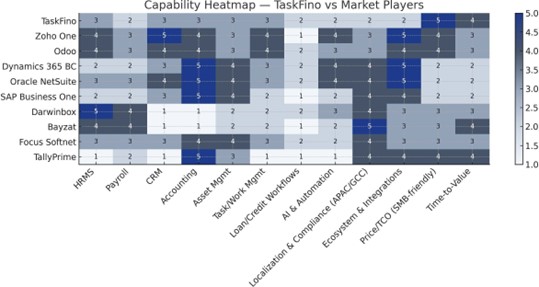
CAPABILITY HEAT MAP (TASKFINO VS MARKET PLAYERS)
What it summarizes
Overall suite breadth and depth across HRMS, Payroll, CRM, Accounting, Asset, Task/Work Mgmt., Loan/Credit workflows, plus AI C Automation, Localization/Compliance (APAC/GCC), Ecosystem C Integrations, Price/TCO (SMB), and Time-to-Value.
Opinions & Methodology. Capability scores, heat maps, and competitive characterizations are opinions based on our methodology, assumptions, and vendor/public materials as of October 2025; they are directional, not statements of fact, and not a substitute for buyer testing or RFPs. Vendors may submit factual corrections with evidence at the contact listed herein.
How to interpret
· Use it to gauge tool consolidation potential and implementation speed.
· Localization/Compliance reflects regional tax/payroll/WPS/e-invoicing posture—not just language.
· Price/TCO considers software + typical partner effort for an SMB deployment.
· Time-to-Value = out-of-the-box fit, templates, and partner maturity (weeks vs months).
Competition State:
· Leaders (suite breadth + VFM): Zoho One, Odoo.
· High-trust, higher-TCO: Dynamics 365 BC, NetSuite, SAP B1.
· Regional HR/payroll specialists: Darwinbox, Bayzat.
· Accounting backbone: TallyPrime, Sage/Xero/QuickBooks.
· Challenger (emerging): TaskFino — aims for Zoho/Odoo’s VFM with GCC/APAC compliance depth and rapid onboarding.
Buyer tip
Shortlisted vendors should still pass reference checks, a security review (SOC2/ISO roadmaps), and a 2– 4-week pilot on real data.
UAE READINESS HEAT MAP
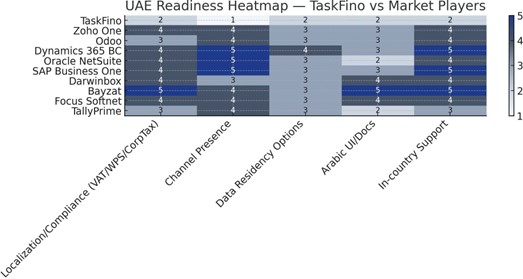
The UAE heat map distils how well each vendor can execute an on-the-ground rollout in the Emirates— where compliance and customer experience hinge on WPS payroll files, VAT/Corporate Tax filings, Arabic UI/Docs, and in-country support. Use it to quickly judge deployment readiness rather than feature checklists: deeper blue indicates a vendor that can move from contract to compliant operations in weeks, with local partners, bank/e-invoicing connectors, and support SLAs that hold up under audit.
Opinions & Methodology. Capability scores, heat maps, and competitive characterizations are opinions based on our methodology, assumptions, and vendor/public materials as of October 2025; they are directional, not statements of fact, and not a substitute for buyer testing or RFPs. Vendors may submit factual corrections with evidence at the contact listed herein.
Factors scored
· Localization & Compliance (VAT/WPS/Corporate Tax) — e.g., WPS SIF file support, VAT C Corporate Tax returns, statutory reports.
· Channel Presence — in-country partners, payroll bureaus, accounting firms.
· Data Residency Options — GCC-friendly regions/tenancy choices.
· Arabic UI/Docs — RTL UI quality, Arabic documentation/support.
· In-country Support — local CS/PS availability and SLAs.
How to use it
· For UAE buyers, weight Compliance and In-country Support highest.
· Ask for evidence (sample filings, WPS file outputs, Arabic screenshots, local partner names).
APAC READINESS HEAT MAP
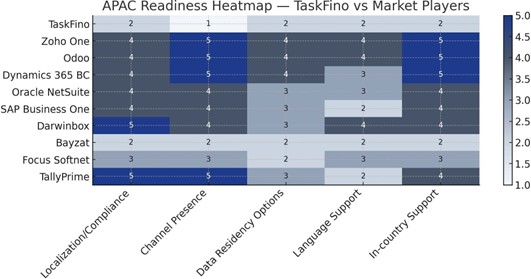
The APAC heat map highlights a vendor’s ability to scale across India and Southeast Asia, balancing country-by-country compliance (GST/e-invoicing, payroll/tax tables), channel presence, language support, and data-residency options. Read it as a guide to multi-country feasibility: the stronger the score, the more likely the vendor can deliver consistent implementations across India/SG/MY/PH (and beyond) with partners, templates, and support capacity that keep time-to-value inside a single quarter.
Opinions & Methodology. Capability scores, heat maps, and competitive characterizations are opinions based on our methodology, assumptions, and vendor/public materials as of October 2025; they are directional, not statements of fact, and not a substitute for buyer testing or RFPs. Vendors may submit factual corrections with evidence at the contact listed herein.
Factors scored
· Localization/Compliance — India (GST/e-invoicing/TDS/EPF/ESI), SG (CPF/IRAS), MY (EPF/SOCSO), PH (SSS/PhilHealth/Pag-IBIG), etc.
· Channel Presence — certified partners across India/SEA.
· Data Residency Options — India/Singapore tenancy where required.
· Language Support — English-first plus key local languages where relevant.
· In-country Support — local CS/PS coverage and implementation toolkits.
How to use it
· For multi-country rollouts, stack-rank by target first-wave countries and confirm each one’s statutory pack and partner bench.
ROADMAP PRIORITIES (NEXT 4–6 QUARTERS)
1. UAE compliance suite (WPS SIF, VAT/Corporate Tax returns, Arabic UI, payroll rules, ESR/PDPL alignment).
2. India compliance suite (GST + e-invoicing, TDS/TCS, EPF/ESI; automated reconciliation).
3. AI automations: AP automation (OCR→GL), AR collections (nudges/WhatsApp), payroll validations, anomaly detection.
4. Banking & payments: reconciliations, salary files, payment approvals; cards/expense mgmt (partners).
5. Partner motion: 50+ certified partners (accounting firms/MSPs) across UAE, India, SG, PH; marketplace starter pack.
6. Trust signals: SOC2/ISO, uptime SLO 99.9%, transparent status page, audit C assurance pack.
BUYER’S CHECKLIST (WHAT TO VALIDATE)
Use this list during discovery, RFPs, and pilots. Ask for evidence, not promises—screenshots, sample files, signed attestations, and named customer references.
1) Legal, Registration & Contracting
· Legal entity details: full legal name, jurisdiction, registration number, registered office (for the contracting entity in your country).
· Who invoices you: local entity vs. foreign; VAT/GST registration number.
· Data Processing Agreement (DPA) and sub-processor list (with change-notification terms).
· IP & indemnity: IP ownership, third-party infringement indemnity, open-source use policy.
· Liability terms: cap (≥ fees paid in last 12 months), exclusions, and specific security/privacy carve-outs.
2) Security, Privacy & Resilience
· Certifications/audits: SOC 2 Type II and/or ISO 27001/27701 (provide report/SoA), recent pen test summary, vulnerability program cadence.
· Identity & access: SSO (SAML/OIDC), MFA options, RBAC C least privilege, admin logs C immutable audit trails.
· Data: encryption in transit/at rest, key management, field-level masking, PII handling, data retention C purge policy.
· Business continuity: RPO/RTO targets, backup frequency, DR region and failover procedure; last DR drill date C outcome.
· SLA & status page: uptime commitment (≥99.9%), support response/restore times, service credit construct, incident communication process.
3) Compliance (UAE, APAC specifics)
· UAE / GCC
o WPS: SIF file generation C successful bank/agent acceptance; payroll variances = 0 in pilot.
o VAT & Corporate Tax: return preparation, journals, and audit trail; sample filings.
o Arabic: RTL UI quality, Arabic payslips/reports, Arabic knowledge base.
o PDPL alignment: data subject rights, deletion, export logs.
· India
o GST & e-invoicing: IRN/QR support via IRP integration; reconciliation to GSTR-2B; E-way bill (if applicable).
o Payroll: TDS/TCS, EPF/ESI, state LWF tables; form outputs.
· SEA exemplars (confirm per target country)
o Singapore: CPF/IRAS tables C forms; Malaysia: EPF/SOCSO; Philippines:
SSS/PhilHealth/Pag-IBIG—plus statutory report formats.
· Country-pack roadmap: named releases with dates, change-log process, and how tax tables are updated C validated.
4) Product Fit & Architecture
· Single data model across HR, Payroll, CRM, Accounting, Assets, Tasks; object relationships (employee ↔ ledger ↔ customer).
· Workflow: multi-step approvals, policy rules, maker-checker for finance, audit evidence export.
· AI features: what is automated (OCR→GL, anomaly detection, next-best-collections, payroll validations), human-in-the-loop controls, explainability C rollback.
· Localization: currency/FX handling, calendar C public holidays by country, multi-entity/multi- branch support.
· Reports & analytics: CFO/COO dashboards, drill-downs, custom reports, export API.
5) Integrations & Extensibility
· Banking: statement feeds, payment files (salaries, suppliers), WPS gateways; reconciliation rules.
· Tax/e-invoicing: connectors for target countries (e.g., India IRP), return file formats.
· Collaboration: WhatsApp/Teams/Email approvals C notifications—capture back to system of record.
· E-commerce/POS/Payroll bureaus: required connectors; SFTP/API options.
· APIs/webhooks: documented coverage, rate limits, sandbox access, SDKs; event bus architecture.
6) Services, Partners & Support
· Implementation plan: clear 4–8 week blueprint by module; sample project plan, RACI, data migration checklist.
· Partner bench: named, certified partners in-country with case studies; who leads design vs. configuration.
· Training & change mgmt.: admin training hours, end-user guides (EN/AR/local), success playbooks.
· Support: hours (local time), channels, escalation path, dedicated CSM, quarterly business reviews.
7) Pricing, TCO & Commercials
· Packaging: module bundles (Core Ops/Commercial/Finance/Complete), per-employee vs per- user rates, AI/Assurance add-ons.
· What’s included: environments, API calls, storage, integrations, support tier, upgrades.
· Implementation effort: expected partner days and daily rates; customizations vs configuration.
· Discounts & term: ramps, multi-year, renewal caps; currency and local invoicing.
· Exit: data export formats (GL, HR, CRM), no-fee export window, assistance terms.
8) References & Proof
· Lighthouse customers: in your country/vertical/size, with 3+ modules live; speak to finance + HR + operations users.
· Before/after metrics: days-to-close, DSO, payroll accuracy, on-time statutory filings, admin hours saved.
· Security/compliance artifacts: redacted SOC2/ISO reports, pen-test letter, sample WPS/GST/VAT/e-invoice outputs.
Pilot & Acceptance (2–4 weeks)
Scope: one payroll cycle, one VAT/GST cycle (mock if needed), 50–100 employees, 200–500 invoices, and 2–3 bank accounts.
· Payroll/WPS: SIF file accepted by bank/agent; variance = 0; payslips generated (EN/AR as required).
· Accounting & tax: sample VAT/GST return produced; journals tie to ledger; audit trail intact.
· AR collections: dunning/WhatsApp/Email flows; DSO projection improves.
· Close: month-end checklist executed; close-time target met.
· Security: SSO/MFA configured; admin/audit logs verified.
· Performance: response times under typical user load; error rate < agreed threshold.
· User adoption: ≥80% target users log in and complete assigned tasks in pilot week 2.
Exit criteria to sign
· Time-to-value ≤60 days for agreed modules.
· All statutory outputs generated C validated.
· Data migration quality ≥99% (baseline vs. new system).
· Support responsiveness within SLA during pilot.
Red Flags (pause & investigate)
Use this as a go/no-go radar during discovery, RFP, and pilot. A single red flag isn’t fatal; two or more in the same area = high risk. Always ask for evidence, not assurances.
1) Registration, Contracting & Structure
· Virtual-only presence with no registry trail. Vendor lists mailbox/virtual offices (e.g., “suite” addresses) but can’t provide company number, incorporation certificate, directors, or local tax reg. Ask for: Legal entity name, registry number, certificate of incorporation, VAT/TRN (UAE), GST (India). Severity: High.
· Different entities for contract vs. invoice with vague rationale.
Ask for: Which entity licenses IP, which invoices, and governing law. Severity: Medium–High.
· No in-region contracting option where data residency or public-sector rules demand it. Ask for: On-shore subsidiary (e.g., UAE free zone, India Pvt Ltd) or approved reseller model. Severity: Medium.
2) Security, Privacy & Compliance
· No SOC 2 / ISO 27001 plan or “we’re compliant” with no audit report/SoA. Ask for: SOC 2 Type II report or ISO 27001 certificate/SoA, pen-test letter, vulnerability mgmt. cadence. Severity: High.
· Opaque incident posture. No status page, no RPO/RTO, vague incident comms.
Ask for: Uptime SLO (≥99.9%), status page, RPO/RTO, last DR drill evidence. Severity: High.
· DPA gaps. No sub-processor list, no deletion timeline, unclear data export. Ask for: DPA, sub-processors with change-notice terms, deletion SLAs, export formats. Severity: High.
3) UAE/GCC Compliance (practical red flags)
· WPS SIF rejections (bank/agent rejects salary files) or repeated variance in pilot.
Ask for: Sample accepted SIF files + bank confirmations. Severity: High.
· VAT/Corporate Tax output requires manual spreadsheets; no audit trail of journal postings.
Ask for: Generated returns, journal links, audit log samples. Severity: High.
· Arabic is superficial. Only login/menus translated; payslips/reports or knowledge base not in Arabic; weak RTL. Ask for: Arabic payslip/report samples, Arabic KB. Severity: Medium.
· No in-country support (time zone mismatch, partner bench thin).
Ask for: Named UAE partners, SLAs, escalation path. Severity: Medium.
4) India/SEA Compliance (practical red flags)
· E-invoicing without IRP integration; can’t show IRN/QR; manual CSV uploads.
Ask for: IRN/QR samples, IRP integration approach. Severity: High.
· GST reconciliation doesn’t tie to GSTR-2B; mismatch handling is manual.
Ask for: Reco screens, exception handling, audit exports. Severity: High.
· Payroll stat tables (TDS/EPF/ESI, LWF) out of date; no dated changelog.
Ask for: Country-pack release notes and effective dates. Severity: Medium–High.
· SEA packs “coming soon” with no dated roadmap (SG CPF/IRAS, MY EPF/SOCSO, PH SSS/PhilHealth/Pag-IBIG).
Ask for: Quarterly country-pack plan. Severity: Medium.
5) Product & Architecture
· AI = marketing veneer. No concrete automations (AP→GL, AR dunning, payroll validations), no human-in-the-loop controls. Ask for: Demo on your data; rollback C audit trail. Severity: Medium.
· Customization dependence. Needs custom scripts for basic payroll/tax/bank files; no versioned config.
Ask for: OOTB templates, version control, upgrade policy. Severity: High.
· Weak auditability. No immutable admin/audit logs; approvals not enforceable (no maker-checker).
Ask for: Audit log export, approval matrix demo. Severity: High.
6) Integrations & Extensibility
· Bank feeds/files “via CSV.” Lacks secure feeds or standard payment formats; no reconciliation rules.
Ask for: Named bank connectors or secure SFTP/process, reconciliation engine demo. Severity:
Medium–High.
· E-invoicing connectors outsourced to spreadsheets; no error handling or retries.
Ask for: Connector catalogue, error queue screenshots. Severity: High.
· Closed APIs. No public docs, no webhooks, sandbox missing.
Ask for: API docs, rate limits, webhook catalogue, sandbox access. Severity: Medium.
7) Services, Partners & Support
· No named in-country partners or references; “we’ll staff remotely.”
Ask for: Two local partner names + case studies. Severity: Medium–High.
· Implementation plan is generic. No 4–8 week blueprint, no RACI/data migration checklist.
Ask for: Detailed plan with week-by-week tasks and acceptance criteria. Severity: Medium.
· Support ambiguity. Unclear hours, escalation path, or named CSM.
Ask for: Support hours (local TZ), SLA, named CSM, escalation tree. Severity: Medium.
8) Pricing, TCO & Commercials
· Opaque packaging. Unlimited add-ons needed for basics; API/storage surcharges hidden.
Ask for: Line-item quote with inclusions (envs, API, storage), renewal caps. Severity: Medium.
· Services overhang. Partner days exceed peers for like-for-like scope; no fixed-fee offers.
Ask for: Benchmarks from similar deals; fixed-fee pilot. Severity: Medium–High.
· Data exit friction. No clear export formats or fees; retention unclear.
Ask for: GL/HR/CRM export formats, no-fee exit window. Severity: High.
9) References & Proof
· Only NDA references; no customer willing to speak.
Ask for: Named references in your country/vertical/size with 3+ modules live. Severity: High.
· Pilot dodging. Reluctance to run one payroll cycle and one tax cycle on sample data.
Ask for: 2–4-week pilot with exit criteria. Severity: High.
10) Roadmap, Governance & Communication
· Roadmap = slogans. No dates, no owners, no acceptance criteria.
Ask for: Dated roadmap, quarterly release notes, change control. Severity: Medium.
· Leadership churn or unclear ownership. Frequent role changes, no accountable execs.
Ask for: Named exec sponsor, escalation contact. Severity: Medium.
SUMMARY (WHAT TO ASK TASKFINO)
· Country coverage today (payroll/VAT/WPS/e-invoicing) and quarterly rollout plan.
· Named bank integrations; WhatsApp/Teams; e-commerce/POS connectors.
· Security attestations; data residency options; backup/DR RPO/RTO.
· Reference customers by vertical and size; time-to-go-live stats.
· Pricing transparency and included support, roadmap commitments in contract.
ANALYST POINT OF VIEW
TaskFino is a credible “Cost-and-Simplicity Challenger” in the all-in-one SMB suite category, targeting firms that want to collapse HRMS, Payroll, CRM, Accounting, Assets, Tasks, and simple Loan workflows into a single platform and go live in weeks, not months. The differentiator that can matter in APAC and the Gulf is not feature breadth per se, but country-level compliance velocity (UAE WPS/VAT/Corporate Tax; India GST/e-invoicing) paired with trust signals (SOC 2/ISO, uptime SLOs, data residency). If TaskFino substantiates these with references and partners, it earns a durable place below mega-suites (Dynamics/NetSuite/SAP B1) and against value incumbents (Zoho/Odoo).
What We Like
· Consolidation story that resonates. SMBs run 7–12 tools today. A single suite with one data model and audit trail meaningfully reduces both tool sprawl and compliance anxiety.
· Time-to-value narrative. “4–8 weeks” with prebuilt workflows is the right promise for mid-market buyers that lack internal IT benches.
· Right first markets. UAE + India offer a high pain-to-price ratio for compliance, plus visible “proof moments” (WPS success, e-invoice IRN issuance).
· AI where it counts. If focused on AP→GL, AR nudges, and payroll validations, AI can remove measurable hours and improve cash conversion—CFO-visible wins.
What Concerns Us
· Localization depth risk. Payroll tables, WPS formats, VAT/Corporate Tax, GST/e-invoicing: each is brittle country-by-country.
· Trust gap vs bigger brands. Buyers default to Microsoft/Oracle/SAP in higher-stake scenarios.
· Ecosystem thinness. Early-stage suites can stall without partners.
KPIs We’ll Watch (quarterly)
· Country compliance coverage (packs shipped/quarter; acceptance receipts).
· Time-to-value (median days to go-live by bundle).
· Adoption depth (avg. modules live per account; WAUs in Admin/Finance/HR cohorts).
· Net revenue retention (NRR) (target >110% via module expansion).
· Implementation leverage (partner-delivered %; services revenue ≤25% of total).
· Trust metrics (SLA adherence, incident transparency, SOC/ISO progress).
ABOUT IHR INSIGHTS
IHR Insights is an independent research and advisory firm delivering market intelligence, custom research, and go-to-market consulting across ICT/Cloud, Data & AI, Security/Telecom, GCC and Healthcare. Beyond vendor/product evaluations, we run primary & secondary research, competitive/benchmark studies, opportunity assessment & market entry, and executive content development (CXO reports, buyer guides).
Our publications stay vendor-neutral and evidence-based—grounded in live product walk-throughs, reference checks, and scenario testing—so leaders can move from slideware to measurable outcomes with clear fit, value, and risk signals. www.ihrinsights.com
Independent research provided “as is”; no warranties or liability. No endorsement or professional advice. Findings may change without notice.
Disclaimer & Limitation of Liability. This report is independent, vendor-neutral research and is provided “as is,” for informational purposes only. IHR Insights makes no warranties (including accuracy, completeness, timeliness, merchantability, fitness, or non-infringement) and disclaims liability, to the maximum extent permitted by law, for any loss or damages arising from use of or reliance on this report. No endorsement or professional advice is implied. Findings reflect IHR Insights opinions as of the publication date and may change without notice; no duty to update is assumed.
Corrections. If you believe this report contains a factual error or uses your IP beyond fair use, email sreeni@ihrinsights.com with supporting evidence; we will review and, if substantiated, issue a correction or takedown within 10 business days