Top Loader Agent AI — Decision Spotlight
This report distils the Top Loader Agent AI proposition into a clear, decision-ready view for executives and investors. It combines a SCOT analysis (strengths, challenges, opportunities, threats) with an evidence- based Product–Market Fit assessment, Middle East (UAE-first) market outlook, and a head-to-head competitive heat map across AI calling, dialling, workflow depth, governance, security, and analytics.
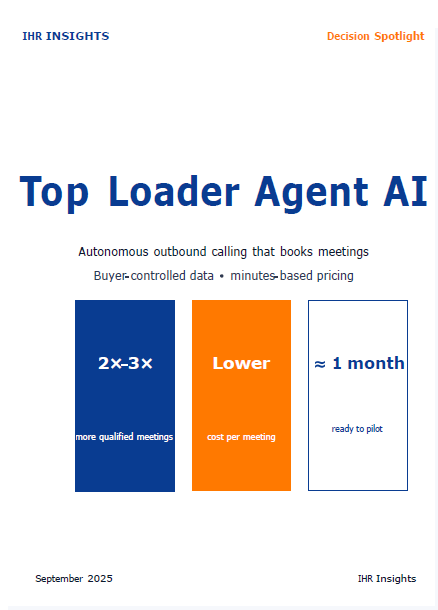
Top Loader Agent AI — Decision Spotlight
What it does, where it wins, how to adopt.
This report distils the Top Loader Agent AI proposition into a clear, decision-ready view for executives and investors. It combines a SCOT analysis (strengths, challenges, opportunities, threats) with an evidence- based Product–Market Fit assessment, Middle East (UAE-first) market outlook, and a head-to-head competitive heat map across AI calling, dialling, workflow depth, governance, security, and analytics.
We also include an investor take on unit economics, an adoption verdict (what it will take to “cross the chasm”), and a pragmatic buyer-side caution checklist mapped to the Top Loader Agent AI agreement and delivery plan.
The aim: help you validate scope vs. timeline, quantify value creation (calls → qualified meetings → pipeline), and de-risk compliance, data ownership, and operating SLAs—so you can make a confident go/no-go and negotiate the right acceptance tests, pricing exhibits, and support terms.
EXECUTIVE SNAPSHOT
At a glance, this section captures what leaders need to know to green-light or pause: what the solution is (a full-stack, high-volume AI calling platform with a data-ownership edge), the real-world proof that it’s wanted (signed design-partner in Dubai), the commercial shape (simple minutes-based model with modular add-ons), and the execution path (a lean, costed MVP plan with clear milestones).
Top Loader Agent AI Specs drafted; development pending - Note - what it takes to reach MVP and scale.
· What it is: Full-stack AI voice platform for high-volume outbound calling with first-party CRM, analytics, campaign tools—and a differentiator around client-exclusive lead data (via blockchain or a strong non-chain fallback).
· Traction signal: A signed license/implementation agreement with a design-partner real estate agency in Dubai, with clear install + subscription terms.
· Commercial anchor: $2,500/month for ~9,000–10,000 calling minutes (rollover allowed), plus low- friction add-ons (DIDs, knowledgebases).
· Build plan C budget: 27-week MVP with Week-25 launch target; Dubai team of 1 CTO + 2 engineers; total est. cost AED 599,547; detailed delivery phases through Launch C Post-launch.
Attribution. All product roadmaps, pricing, performance targets, case metrics, availability dates, and compliance postures referenced herein are as represented by Top Loader Agent AI at the time of drafting and were not independently audited by us.
SCOT ANALYSIS
This SCOT frames Top Loader Agent AI’s next 6–12 months in the market—separating what’s proven (signed design partner, install model, pricing) from what’s assumed (scale, compliance operations, channel mix). Strengths highlight structural advantages we can defend; Challenges call out execution and regulatory frictions we must de-risk; Opportunities focus on near-term revenue beachheads and expansion paths; Threats track incumbent CCaaS bundles and fast-moving AI voice upstarts. Read this section as an action filter: double-down where we win, time-box experiments where proof is pending, and assign owners/mitigations where risk can stall adoption.
Strengths
· Signed customer license (design-partner): proves willingness to pay; fast path to usage data and references.
· Clear, simple pricing - vendor indicates (minutes-based; “pay only when connected”) with practical upsells (numbers, KBs).
· Differentiator: client-exclusive access to lead data (blockchain model; fallback to conventional encryption if needed).
· Vendor redundancy across VAPI/Retell/Twilio (cost negotiation + failover).
· Full funnel: campaigns → AI calls → meetings → analytics; enterprise security C MFA planned.
Challenges
· Telecom/API costs sensitivity; margins hinge on minute rates and connect rates (mitigations noted but real).
· Time to full MVP ~6 months; a “core MVP” could go live earlier but without blockchain C advanced features.
· Regulatory complexity: UAE telecom C consent rules; evolving stance on blockchain.
· Founder-led selling early; need repeatable motion (sales + CS) after pilots.
Opportunities
· Large, growing TAM (AI contact center through 2030), with security-sensitive verticals (RE/FS) as wedges.
· Dubai beachhead (bilingual, compliance-focused) then EU on GDPR fit; later NA + broader verticals.
· Unit-economics leverage at scale via provider discounts + call-time optimization (scripting, sentiment).
Threats
· Cloud CCaaS (Contact Center as a Service)—cloud contact-center platforms like Five9, Talkdesk, RingCentral bundling GenAI faster; conversational AI pure-plays (Air.ai, Bland) press on ease-of-use.
· Channel/CRM locks (Salesforce, HubSpot) can neutralize SMB demand with native add-ons.
· WhatsApp-first outreach norms in MENA might reduce voice minutes unless WhatsApp/SMS flows are integrated (email/SMS planned; WA not yet specified).
PRODUCT–MARKET FIT (PMF)
The working PMF hypothesis is that outbound teams in real estate and financial services will allocate budget to platforms that reliably increase qualified meetings while reducing manual effort, conditional on three acceptance gates:
(1) human-parity voice quality and latency,
(2) clean, auditable compliance, and
(3) buyer-controlled data ownership.
Evidence to date—namely a signed design partner and acceptance of a minutes-based commercial model—indicates problem–solution fit; the question now is repeatability at scale.
We define PMF operationally as 30–60-day pilots demonstrating ≥2× uplift in qualified meetings per agent vs. baseline, a lower cost per meeting, stable or improved show-up rates, and positive user sentiment on voice/latency and compliance. The “client-exclusive lead data” capability (blockchain or conventional controls) is treated as a win-rate amplifier rather than a dependency; it will be A/B tested, with a default to the non-chain path if no measurable conversion lift is observed.
Problem–solution: Agencies and FS teams drown in unqualified leads and manual follow-ups; product automates qualification, books meetings, and surfaces analytics—plus trust signal via data isolation.
Evidence
· Design-partner license C install terms locked, measurable usage from minute packs.
· Warm pipeline (2 RE agencies + 1 wealth firm) pending MVP; phased Dubai → EU→ NA plan.
PMF risk: Some buyers may view blockchain as “nice-to-have”; the plan explicitly validates this in pilots and can pivot to conventional security without delay.
What to measure in pilots (Dubai, Q1–Q2 2026)
· Connect rate, qualified-meetings per 100 dials, $/meeting, show-up rate, 30-day pipeline lift; NPS for voice quality C data trust.
Middle East (UAE-first) market view
· Fit: Real estate C FS are heavy outbound + consent-sensitive—aligned to the product’s
compliance posture and data isolation.
· Go-to-market: Founder-led outreach + LinkedIn + industry bodies; initial digital budget seeded.
· Regulatory stance: Plan bakes in consent tracking, audits, and UAE data/privacy compliance; telecom constraints acknowledged; legal budget set.
· Localization: English/Arabic UX is planned in the broader vision—good for Dubai; ensure Arabic voice quality and slot in WhatsApp flows next.
Verdict: Right first beachhead with credible access; ensure local DIDs, Etisalat/du routing quality, Arabic TTS/ASR, and WhatsApp fallbacks to maximize reach.
MARKET ADOPTION ASSESSMENT
This section estimates near-term adoption. We triangulate demand readiness, solution readiness, and route-to-market efficiency.
We benchmark Top Loader Agent AI against incumbent CCaaS bundles and AI upstarts, then model a 6–12 month path from demo → pilot → paid using leading indicators: demo-to-pilot conversion, pilot-to-paid conversion, qualified meetings per 100 calls, cost per meeting vs. baseline, show-up rates, and user sentiment on voice/compliance. Adoption gates to watch are Arabic ASR/TTS performance, WhatsApp/SMS fallbacks, local DID/CLI reputation and consent/recording pack readiness. We present base, upside, and conservative scenarios with triggers (two referenceable Dubai wins, published ROI case study, partner distribution) and stall risks (carrier quality variance, dialler governance, incumbent bundling). Use this assessment to align go-to-market pacing, acceptance thresholds, and the order of investments that most efficiently convert interest into recurring usage.
Near-term (next 6–G months): With one live design partner and 1–2 more pilots, yes—if Top Loader Agent AI hit demo parity (voice quality + latency), publish compliance pack, and prove $ per meeting improves against baselines. The delivery plan through Week 27 is well-specified.
Medium-term: Scales if minute-economics are controlled and channel partnerships (CRM/real-estate communities) unlock distribution.
WHAT MUST BE PUT IN PLACE (CHECKLIST)
1. “Ready-to-buy” bundles: Minutes pack tiers (Starter/Pro/Scale), overage, SLA, success plan. (Price cards already sketched.)
2. Compliance kit: UAE consent language, recording notices, Do-Not-Call governance, DIAC arbitration referenced in contracts.
3. Arabic voice: Evaluate Arabic TTS/ASR and latency; test with live Emirati accents before broad roll- out.
4. WhatsApp/SMS paths: Complement voice for unreachable leads; email/SMS is in plan—extend to WA next.
5. Referenceable pilots: 2 Dubai agencies + 1 FS firm with published case metrics (calls → meetings
→ pipeline).
6. Sales/CS hires: Sales Manager + CSM in Year 1 to make motion repeatable.
Ideal customers (ICP)
· Real estate: Brokerages/developers with 30–300 agents; large portal lead flow; need appointment-setting at scale.
· Financial services: Retail banking/wealth/insurance telesales teams with strict privacy posture.
· Later: E-commerce C healthcare contact teams once Dubai PMF is proven.
COMPETITORS POSITIONING
This section situates Top Loader Agent AI against three buyer shortlists: CCaaS incumbents (Five9, Talkdesk, RingCentral, Genesys/Amazon Connect) that win on dialler depth, integrations and enterprise ops; AI voice upstarts (Air.ai, Bland.ai, others) that showcase autonomy but rely on customers to stitch workflows; and CRM-centric stacks (Salesforce/HubSpot + telephony) that trade autonomy for embedded data and process.
We compare on five decision axes—autonomous call quality/latency, workflow depth (campaigns, CRM, meetings), governance C consent, data ownership/segregation, and time-to-value C localization (MENA)— because these are where deals are won or neutralized. Read the pages that follow as a positioning map: what is table-stakes (reliable dialling, analytics), what is a defensible differentiator (client-exclusive lead data, on-prem/your-infra deployment), and what are neutralizers needed to remove easy objections (predictive dialler parity, WhatsApp/SMS fallbacks, Arabic ASR/TTS). We also call out segment nuances (Real Estate vs Financial Services) and the message house to press in competitive meetings: lead with speed-to-value + governance + data control, then prove ROI with meetings/bookings per 100 calls.
Who shows up in deals
· CCaaS majors: RingCentral, Five9, Talkdesk.
· AI voice upstarts: Bland AI, Air.ai, Convin.ai.
· CRM suites: Salesforce, HubSpot (telephony add-ons).
How you stack
· Win on trust: Client-exclusive data access (blockchain or equivalent) is rare; leverage for RE/FS.
· Win on completeness: Calls + CRM + meetings + analytics in one pane (most rivals require stitching).
· Risk: Majors can undercut with bundles; counter with minutes clarity, faster setup, and MENA localization.
Investors take (unit economics plan realism)
· Revenue model tightly linked to usage; $2.5k for ~10k minutes anchors ARPU for mid-market teams; upsell paths exist.
· COGS risk acknowledged with multi-provider leverage and script optimization (20–30% call-time reduction target).
· Build efficiency: Lean 3-person team with phased scope; costs enumerated and time-boxed to Week-25 MVP + Week-27 launch.
· Scaling plan: Add Sales + CS in Year-1; then measured eng/marketing hires.
· Upside model: Break-even at ~50 clients; Year-3/5 surplus targets are ambitious—credible if distribution/partnerships click.
Investor to watch: Prove that blockchain-grade privacy materially lifts win-rate vs “good enough”
encryption; your plan to A/B validate in pilots is the right approach.
COMPETITIVE LANDSCAPE
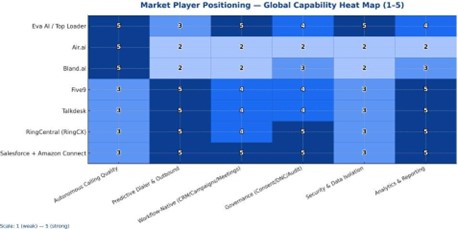
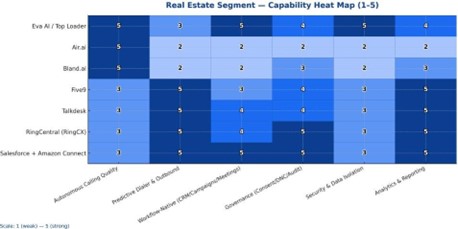
The chart below benchmarks seven market options across six buyer decision dimensions—Autonomous Calling Quality, Predictive Dialler C Outbound, Workflow-Native (CRM/Campaigns/Meetings), Governance (Consent/DNC/Audit), Security C Data Isolation, and Analytics C Reporting—on a 1–5 scale (5 = strong native capability under typical configurations; 3 = partial/assembly required; 1 = weak). Colour intensity increases with strength. Scores synthesize vendor materials, demo evidence, and deployment assumptions for a Dubai/UAE-first context.
Capability scores, heat maps, and competitive characterizations are opinions based on our methodology, assumptions, and publicly available or vendor-supplied materials; they are directional, not statements of fact, and not a substitute for buyer testing or RFPs. Vendors may submit factual corrections with evidence at the contact listed herein.
Read row-wise to see each vendor’s capability profile and column-wise to spot table-stakes vs. differentiators.
Use this as a positioning map to decide where Top Loader Agent AI should press its edge (autonomous calling + workflow depth + data ownership) and where to add neutralizers to remove easy objections (predictive dialler parity, Arabic ASR/TTS, WhatsApp/SMS fallbacks). Segment-specific views (Real Estate and Financial Services) are available where buying criteria diverge.
Opinions & Methodology. Capability scores, heat maps, and competitive characterizations are opinions based on our methodology, assumptions, and vendor/public materials as of September 2025; they are directional, not statements of fact, and not a substitute for buyer testing or RFPs. Vendors may submit factual corrections with evidence at the contact listed herein.
Opinions & Methodology. Capability scores, heat maps, and competitive characterizations are opinions based on our methodology, assumptions, and vendor/public materials as of September 2025; they are directional, not statements of fact, and not a substitute for buyer testing or RFPs. Vendors may submit factual corrections with evidence at the contact listed herein.
Heat Map Readout — Key Signals (Note - Top Loader Agent AI Specs drafted; development pending)
This readout distils the capability grid into the few signals that matter for near-term buying: where each vendor is natively strong, where capability requires assembly or integrations, and where gaps could stall adoption. Scores are directional (1–5) for a Dubai/UAE-first context; read row-wise for each vendor’s profile and column-wise for table-stakes vs. differentiators. Use the takeaways below to decide where Top Loader Agent AI should press its edge (autonomy, workflow-native stack, data ownership) and where to add neutralizers (dialler parity, Arabic ASR/TTS, WhatsApp/SMS fallbacks) to remove easy objections and accelerate pilot-to-paid conversion.
· Eva AI / Top Loader leads on the essentials for PMF in RE/FS: autonomous outbound, built-in CRM, campaign engine, meeting scheduling, analytics, compliance, and client-exclusive data ownership (blockchain option and strong contract posture).
Pricing is clear (minutes-based, rollovers) and codified in the license.
Gaps to close now: predictive dialler mode, WhatsApp channel, Arabic voice QA, UAE DID coverage declaration.
· Air.ai based on public materials as of Sept-2025 is best known for long, human-like autonomous calls (10–40 minutes). Evidence is strong on autonomy but light on CRM/campaign depth in public materials.
· Bland.ai is a great “builder” platform (fast API to place/receive AI calls); strong for teams that want to wire up their own workflows, but it won’t replace a CRM/campaign stack out of the box.
· FiveG / Talkdesk / RingCentral (RingCX) are dialer/campaign powerhouses with enterprise analytics and compliance. Their AI is robust for self-service and agent-assist; truly autonomous outbound varies by configuration and often leans more “dialer + agent.”
· Salesforce + Amazon Connect wins on “own your CRM + HVOC,” but autonomy is typically bot- first for service and requires assembly; pricing is enterprise/quote-led.
Evidence highlights for competitors
· Air.ai: “full on 10–40 minute” human-like AI calls.
· Bland.ai: API to “send or receive phone calls where an AI speaks to a human.”
· FiveG: Predictive/Power/Progressive dialers; IVA; mature analytics suite.
· Talkdesk: Autopilot (GenAI self-service), Proactive Outbound w/ agentless voice C SMS campaigns, Predictive Dialer C campaign APIs.
· RingCentral (RingCX): Outbound dialers + campaign mgmt, predictive dialer controls, analytics; mentions AI receptionists.
· Salesforce + Amazon Connect: High-Volume Outbound Calls (HVOC) setup and Service Cloud Voice.
Where to press advantages vs each cohort
· Vs. Air/Bland (AI upstarts): Lead with all-in-one workflow (CRM + campaigns + meetings + analytics) and client-exclusive data (blockchain or conventional isolation), which they typically lack out-of-box.
· Vs. CCaaS majors: Lead with speed to value (1-month install), simpler minutes pricing, and
vertical templates (RE/FS). Add predictive dialer parity soon to remove an easy objection.
Immediate upgrade backlog (to move more your way)
1. Predictive dialler mode (preview/progressive/predictive) to complement AI agents.
2. WhatsApp channel (SMS/Email already planned) and Arabic voice quality QA with Emirati dialect test sets.
3. Publish UAE DID carrier routing posture (Etisalat/du) in a one-pager.
4. Compliance pack (consent scripts, recording notices, DNC governance) for UAE + GDPR—map to your contract terms.
60–G0-Day Execution Plan Decision Gates
Top Loader Agent AI Specs drafted; development pending
This section lays out the near-term operating plan and the objective gates that determine whether the program advances, holds, or exits. We translate the thesis into measurable checkpoints—Demo → Pilot → Paid—with minimum thresholds for voice/latency, qualified meetings per 100 calls, cost per meeting vs. baseline, show-up rates, abandonment, and SLA readiness (uptime, incident response). We also surface critical dependencies (Arabic ASR/TTS quality, UAE DID/CLI reputation, WhatsApp/SMS fallback, compliance pack, training assets) and list the risks/mitigations tied to third-party voice providers and data- handling. Read this as a pacing tool: what must be true in the next 60–90 days to proceed, what evidence is required at each gate, and which actions unlock scale most efficiently.
Go—with milestones:
1. Core MVP demo by Week-12 to 1–2 Dubai pilots (voice quality, basic CRM, simple analytics).
2. Publish compliance pack (consent scripts + data sheet) and minute-based price cards.
3. Prove ROI: 30-day pilot aiming for ≥2× more qualified meetings per agent vs. baseline.
4. Lock 2 references; then scale to 8–12 paying teams in Dubai; prepare EU proof on GDPR with/without blockchain.
Ǫuick due-diligence checklist (Top Loader Agent AI Specs drafted; development pending)
1. Telecom Quality: UAE carrier routing test report; price-lock + failover proof; latency C abandon benchmarks from your pilot.
2. Compliance Pack: Consent/recording scripts, DNC governance, privacy/data maps; who bears legal responsibilities per clause 9.
3. Security Hosting: Diagram of where data lives (your infra vs vendor), key management, support access model, breach RACI.
4. Scope Phasing: What’s delivered at install (≈1 month) vs Week-25/27 features; milestone-tied payments and acceptance tests.
5. Pricing Exhibit: Minute rating granularity, overage, rollover mechanics, DID C KB add-ons, SLA credits.
6. Blockchain Decision: Go/no-go with acceptance criteria; if “no,” confirm conventional security plan and remove dependencies from launch.
7. Analytics SLOs: Define accuracy/latency SLOs; require the analytics API and monitoring deliverables at launch.
8. Training CS: Ask for multi-format training, a 30-day success plan, and defined escalation paths.
9. Exit Plan: File formats, export SLA, costs, and post-termination support window; DIAC logistics.
BUYER CAUTIONS - TOP LOADER AGENT AI SPECS DRAFTED; DEVELOPMENT PENDING
1) Scope vs. timeline (install ≈1 month vs. full MVP)
Business Impact: The agreement promises to delivery C install on your servers in ~1 month, but the full MVP feature set lands via a 27-week plan (bulk campaigns, meetings, analytics, compliance hardening, optional blockchain). Misaligned Day-1 expectations cause friction.
Evidence to Obtain: A one-page “Day-1 Acceptance” checklist (what’s usable at install), then Week-25 MVP scope with pass/fail tests (latency, analytics, meetings). Cite these milestones in the SOW.
2) Commercial model clarity (minutes, rollover, overage)
Business Impact: Pricing anchors on 9,000 “connected” minutes at USD 2,500/mo; charges apply only when AI is engaged. You need rating granularity (per-sec vs 30/60-sec), overage rates, and a clean definition of “connected” to forecast costs.
Evidence to Obtain: A Pricing Exhibit that defines “connected minute,” billing increments, overage, DIDs and knowledge-base add-ons.
3) Data ownership support access model
Business Impact: Data is your property and lives on your servers; the Licensor states no access after install. That’s great for control, but it can slow support unless a “break-glass” path is agreed.
Evidence to Obtain: A DPA with (a) masked log access, (b) time-boxed support access, (c) export formats C deletion SLA.
4) Operational SLAs vs. roadmap targets
Business Impact: The build plan targets GG.G% uptime, ≤2s API responses, and ~1,000 concurrent calls,
but these are roadmap targets, not contractual SLAs.
Evidence to Obtain: Convert those targets into an SLA with uptime %, incident tiers/response times, credits, and concurrency limits tied to number inventory.
5) Third-party voice provider dependency
Business Impact: Quality/cost rely on VAPI/Retell/Twilio; provider shifts affect latency, ASR/TTS quality, and price. The plan proposes multi-provider redundancy C fallbacks—make sure it’s proven in your countries.
Evidence to Obtain: A carrier/quality test in your market and the failover runbook. Include a line item in the SLA for provider outages and routing mitigation.
6) Governance: consent, recording, telecom rules (UAE first)
Business Impact: The agreement makes both parties comply with UAE laws; Annex A places consent and lawful contacting obligations on you. You’ll want scripted consent flows and evidence logging ready.
Evidence to Obtain: A compliance pack: consent scripts (voice/SMS/email), recording posture, DNCR suppression, and a consent-evidence log (audio clip + timestamp).
7) Training change management
Business Impact: Training in the contract is a 20-minute video—insufficient for non-technical teams running campaigns, pacing, and analytics.
Evidence to Obtain: A training plan (admin + user), playbooks, and first-30-days success checkpoints as acceptance criteria.
8) Feature completeness at go-live (campaigns, meetings, analytics)
Business Impact: Campaigns, meeting scheduling, and advanced analytics are planned across Weeks 9–
19. If these are core to your use-case, ensure they’re in the phase you’re paying for.
Evidence to Obtain: A phased feature list with must-haves tagged and a rollback plan if a phase slips. Add pass/fail tests for analytics accuracy and meeting creation.
9) Blockchain option vs. conventional security
Business Impact: The MVP includes blockchain-secured lead data; it’s a differentiator, but adds operational complexity (keys, performance, on-chain ops).
Evidence to Obtain: Decide “chain vs. no-chain” up front. If “on-chain,” define key custody, node hosting, RTBF handling, and performance budgets; if “no-chain,” confirm equivalent encryption C access controls.
10) Updates future versions
Business Impact: Vendor may ship updates/enhancements with extra terms/fees; you’ll want notice windows and backward-compatibility expectations.
Evidence to Obtain: An update policy (notice period, version support windows) and a change-log commitment.
11) Support commitments vs. liability
Business Impact: There’s a one-year warranty and 48-hour max to address concerns, but no explicit liability cap/credits in the base text.
Evidence to Obtain: A support/SLA schedule (response/restore times + credits) and a mutual liability cap (e.g., 12-month fees), especially for prolonged outages or data loss.
12) On-site requirement
Business Impact: The agreement obliges you to provide a private, designated temporary space at your office—unusual for software installs; clarify scope and security hygiene.
Evidence to Obtain: An on-site protocol (device hygiene, data handling, dates, who attends) so the clause
doesn’t create audit or safety gaps.
13) Exit, portability disputes
Business Impact: On termination, usage stops and fees are due; your data remains yours, and DIAC (Dubai) arbitration applies—good to know how you’ll export data.
Evidence to Obtain: A portability exhibit (export formats, timing/costs) + post-termination support window.
COMMON BUYER OBJECTIONS
This section anticipates the questions sophisticated buyers will raise before piloting or signing—centered on voice quality/latency, dialler parity, language and channel coverage, compliance and liability, data control, reliability/SLA maturity, pricing clarity, integration effort, and exit risk. Each objection is paired with the why it matters, a crisp response strategy, and the proof points you should have on hand (call clips, latency histograms, consent evidence logs, SLA schedules, pricing exhibits, export samples).
Use this as a deal hygiene checklist: pre-empt the top risks in your demo, attach the right exhibits to the SOW, and turn objections into measurable pilot gates rather than open-ended debates.
1) “Will the AI sound human enough—and be fast enough?”
· Why it matters: Latency/voice quality drives trust and conversion.
· Pre-empt / answer: Commit to turn-latency SLOs (e.g., median ≤1.2s, p95 ≤2.0s) and share real call clips across accents/environments.
· Proof to bring: Pilot KPI pack: latency histograms, barge-in handling, call samples, ASR/TTS vendor mix.
2) “Predictive dialler parity?”
· Why it matters: Dialler modes (predictive/progressive/preview) are table stakes for high-volume outbound.
· Pre-empt / answer: Show current mode + roadmap; if needed, run mixed-mode (preview/progressive) during pilot and time-box predictive delivery.
· Proof to bring: Pacing policy, abandonment controls (≤3%), “info message” flows on abandoned calls.
3) “Arabic (and other) language performance?”
· Why it matters: UAE buyers need Arabic ASR/TTS that handles dialects and code-switching.
· Pre-empt / answer: Present test results by dialect; offer vocabulary injection and accent-specific voice options; run a language-fit pilot slice first.
· Proof to bring: WER/latency by dialect, confusion-matrix examples, tuning plan.
4) “What about WhatsApp/SMS follow-ups?”
· Why it matters: Voice alone may miss contacts; MENA expects WhatsApp.
· Pre-empt / answer: Show messaging path (SMS/email live; WA timeline or partner). Map opt-in, template approvals, and consent evidence.
· Proof to bring: Channel architecture, sample templates, consent evidence log.
5) “Compliance recording risk—who’s liable?”
· Why it matters: TCPA/PECR/PDPL/DNCR exposure sits with the caller.
· Pre-empt / answer: Provide a compliance pack: AI disclosure line, location-aware recording gates, consent capture/evidence storage, DNC suppression.
· Proof to bring: Scripts, consent audio snippets, jurisdiction matrix, audit exports.
6) “Data ownership privacy—who can see our leads?”
· Why it matters: RE/FS treat lead data as crown jewels.
· Pre-empt / answer: Data resides on buyer infra; vendor has no default access. Offer “break-glass” support with masked logs. Blockchain option is additive, not required.
· Proof to bring: DPA, data map, access audit trail sample, export/deletion SLAs.
7) “Vendor lock-in / exit?”
· Why it matters: Buyers want reversibility.
· Pre-empt / answer: Contract an export C transition exhibit (CSV/JSON + audio), 5-day export SLA, and post-termination support window.
· Proof to bring: Redacted export sample, runbook for handover.
8) “Reliability support maturity?”
· Why it matters: Downtime kills campaigns.
· Pre-empt / answer: Convert roadmap targets into SLA: uptime %, incident tiers, response/restore times, credits. Share on-call runbook and monitoring stack.
· Proof to bring: Prior incident post-mortem template, synthetic-call dashboards, SLA schedule.
9) “Telecom/provider dependencies (Twilio/Retell/etc.)—cost/quality swings?”
· Why it matters: Minute economics and audio quality vary by route/provider.
· Pre-empt / answer: Multi-provider routing with failover; UAE carrier tests; price-lock windows where possible.
· Proof to bring: Carrier QA report (Etisalat/du), route failover demo, provider contracts summary.
10) “Analytics accuracy—can we trust the insights?”
· Why it matters: Bad sentiment/intent classification misguides teams.
· Pre-empt / answer: Define accuracy SLOs; show labelling/QA process; expose raw transcripts + explainability for key signals.
· Proof to bring: Confusion matrices, sample audits, API/docs for analytics export.
11) “Commercial clarity—how do minutes, overage and rollovers really work?”
· Why it matters: CFOs hate surprise bills.
· Pre-empt / answer: Per-second rating; clear ‘connected minute’ definition; listed overage + DID/KB add-ons; 6-month rollover.
· Proof to bring: Pricing exhibit, sample invoice, dispute window clause.
12) “Change management—can our teams actually use it?”
· Why it matters: Adoption stalls without enablement.
· Pre-empt / answer: Training kit beyond a video (admin/user playbooks, objection handling, first- 30-days success plan); CS check-ins.
· Proof to bring: Playbook excerpts, sample cadences, enablement calendar.
13) “On-prem install on our servers—heavy lift?”
· Why it matters: IT effort, security reviews.
· Pre-empt / answer: One-month install target; infra prerequisites checklist; containerized deployment; rollback plan.
· Proof to bring: Architecture diagram, sizing guide, pre-flight checklist, rollback procedure.
14) “Blockchain scepticism—extra complexity for what?”
· Why it matters: Some buyers see it as overhead.
· Pre-empt / answer: Position as optional “trust booster.” Default to conventional encryption/segregation unless A/B proves win-rate lift.
· Proof to bring: A/B test design, non-chain security controls, performance budget.
15) “Integrations—will it work with our CRM/meeting tools?”
· Why it matters: Broken handoffs kill ROI.
· Pre-empt / answer: Show native CRM/Calendar hooks or webhook-based approach; commit to a limited integration scope for pilot.
· Proof to bring: Integration catalogue, sample payloads, Postman collection, sandbox creds.
16) “Competitive bundling—FiveG/Talkdesk/RingCX/SFDC can ‘just include it’”
· Why it matters: Incumbents neutralize with bundles/credits.
· Pre-empt / answer: Lead with speed-to-value, data ownership on buyer infra, and pilot ROI on meetings-per-100-calls; price vs. value framing (minutes model).
· Proof to bring: 30–60-day pilot results, reference logos, side-by-side capability map.
ANALYST COMMENTARY — BUILD STATUS READINESS
Top Loader Agent AI is at a pre-build stage: specs drafted; development pending. That means problem framing, scope, and commercials are clear, but there is no production artifact yet to validate latency, call quality, dialler parity, Arabic ASR/TTS, or WhatsApp flows. In market terms, we treat all capability claims as design intent until backed by demo/pilot evidence; adoption pacing should therefore run Demo → Pilot → Paid with explicit acceptance gates (meetings/100 calls, cost per meeting, show-up rate, consent/recording proof, uptime/latency SLOs).
What this implies for the next decision window: prioritize a core MVP that proves the few things buyers won’t compromise on—human-sounding voice at low latency, clean consent/recording, minutes pricing clarity, and data ownership on buyer infra—before investing in differentiators (e.g., blockchain trust layer). Contract artifacts should include an SLA schedule, Pricing Exhibit (connected-minute definition, increments, overage, rollover), and a Compliance Pack (disclosure scripts, DNC, evidence logging). If these are delivered alongside a small number of referenceable Dubai pilots, the path to paid usage is credible; if not, push timelines or reduce scope until those proof points exist.
Confidence triggers (up/down):
· Up: Week-12 demo hitting latency/voice targets; first pilot shows ≥2× qualified meetings/agent vs baseline; consent evidence logs operational; two reference logos.
· Down: Slippage on predictive dialler parity, Arabic ASR/TTS quality, or UAE DID/CLI posture; unresolved SLA/pricing exhibits; inability to export data cleanly on request.
ABOUT IHR INSIGHTS
IHR Insights is an independent research and advisory firm delivering market intelligence, custom research, and go-to-market consulting across ICT/Cloud, Data & AI, Security/Telecom, and Healthcare. Beyond vendor/product evaluations, we run primary & secondary research, competitive/benchmark studies, opportunity assessment & market entry, and executive content development (CXO reports, buyer guides). Our publications stay vendor- neutral and evidence-based—grounded in live product walk-throughs, reference checks, and scenario testing— so leaders can move from slideware to measurable outcomes with clear fit, value, and risk signals. www.ihrinsights.com
Independent research provided “as is”; no warranties or liability. No endorsement or professional advice. Findings may change without notice.
Disclaimer & Limitation of Liability. This report is independent, vendor-neutral research and is provided “as is,” for informational purposes only. IHR Insights makes no warranties (including accuracy, completeness, timeliness, merchantability, fitness, or non-infringement) and disclaims liability, to the maximum extent permitted by law, for any loss or damages arising from use of or reliance on this report. No endorsement or professional advice is implied. Findings reflect IHR Insight’s opinions as of the publication date and may change without notice; no duty to update is assumed.
Corrections. If you believe this report contains a factual error or uses your IP beyond fair use, email sreeni@ihrinsights.com with supporting evidence; we will review and, if substantiated, issue a correction or takedown within 10 business days.