Artificial Intelligence In Healthcare
The AI evolution concept can be related to the way a child learns. Wrong concepts and misguidance is unfavourable for the child’s future while lack of education or training leads to blissful ignorance! Likewise, the training and/or learning process of the machines should be continuous, with data scientists governing the quality of data being fed.

Executive Overview
Leading research and innovation hub for AI
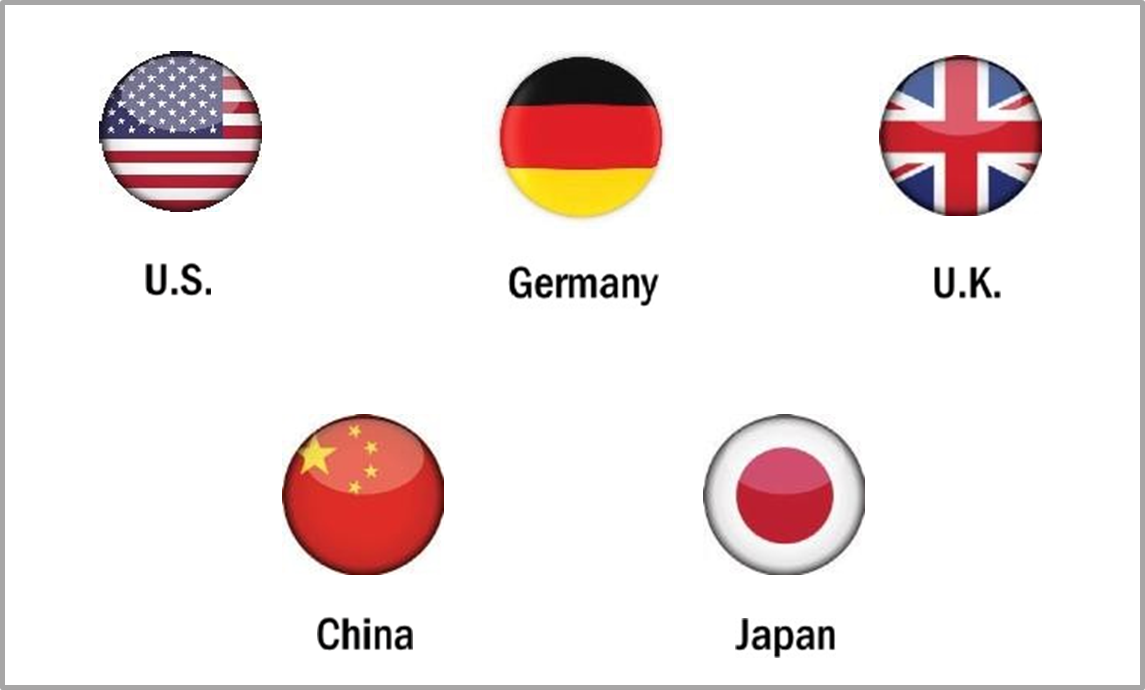
Market Dynamics that make these countries more lucrative for AI based research and development
1. U.S. – hub of technology evolution, with over 1000+ AI companies (including start-ups and tech giants) and over US$10 billion in venture capital funds for R&D
2. Germany – Decline in working population and high propensity of automation, of close to 50% potential estimates across industries
3. U.K. – Studies reveal AI implementation in businesses across U.K have a potential to boost productivity by about 30%, bolstering huge investments in collaborative AI research with leading universities and technology compa- nies across the country
4. China – High penchant to technology development with strong government patronage to become an “economic power” backed by skill development and research in technological breakthroughs. China has produced almost twice as many research papers in AI as compared to the U.S.
5. Japan – Dwindling available workforce, highly prone to natural calamities leading to high propensity for automation
Key Takeaways
This paper is intended to answer the following questions –
Are we ready for artificial intelligence (AI)?
AI framework and existing data ecosystem
- What are the most common AI implementation challenges?
- What are the standard best practices that should be in place?
Future trends and opportunities for AI in Healthcare (case studies)
Recommendations
- For technology developers
- For investors
- For end-users
Artificial Intelligence Readiness
For one moment, let’s all assume to be privileged with equal exposure to a set of extremely efficient and desirable AI platforms, ready to be tailored as per our business requisites. Now, to understand and analyse an organization’s AI readiness, the following questions are few of the areas that should be taken into considerations –
What are the top 2 priorities that your company has or would be willing to invest in, as a part of its AI based digital transformation initiatives?
Is your organization already using AI driven approach for key business functionalities such as marketing campaigns? If yes, what are the key aspects of this initiative that you believe is making a difference in creating new growth areas for your organization? (choose the relevant options)
o Real-time customer support across multiple channels or touchpoints
o Understanding behaviour patterns to personalise and enhance customer experience
o Understanding behaviour patterns to identifying new customers
o Identify and analyse key customer pain points (from emotional cues) to add new/ enhance existing service offerings
o Analyse and score key internal performance metrics
o To manage and optimize internal operations across business functions
On a scale of (1-5, 5 – highest/strongly agree, 1 – lowest/completely disagree, 3 - don’t know /indiffeent/not sure) Do you have the right people and skill sets to define the AI roadmap for your organization?
On a scale of (1-5, 5 being highest) How clearly is your AI based digital transformation strategy articulated?
On a scale of (1-5, 5 being highest) How competent is your workforce in understanding the value proposition of AI in context to setting up a seamless integration between the set customer expectations and across the multichannel client facing environments/ interfaces?
On a scale of (1-5, 5 being highest) How competent is your organization in measuring and clearly articulating the business results of the existing artificial intelligence marketing strategy?
On a scale of (1-5, 5 - highest/strongly agree; 1 - lowest/completely disagree; & 3 - don’t know /indifferent/not sure) How prepared is your organization’s structure and cultural integrity, in terms of taking a strong transformational step towards creating an agile organizational structure (essential for an effective cross functional collaboration within an AI augmented work- flow)?
On a scale of (1-5, 5 being highest) How clearly have you identified the redundant processes for your marketing programs that can be handled by your AI based digital transformation roadmap?
On a scale of (1-5, 5 - highest/strongly agree; 1 - lowest/completely disagree; & 3 - don’t know /indifferent/not sure) Does you company have a dynamic and scalable technology budget for shifting priorities such as moving to agile and scalable cloud-based infrastructure or investing in multichannel digital experience platform to support AI driven digital transformation?
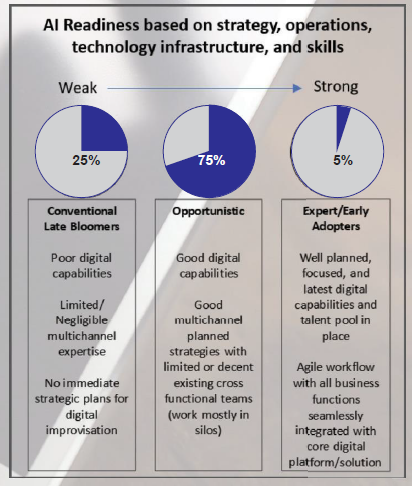
The chart below showcases the AI readiness of organizations globally based on multiple surveys done across a balanced spread of large MNCs, small & medium enterprises, and start-ups (Note: this data is for organizations across indus- tries and not specific to healthcare – FYI: healthcare has shown significantly higher readiness than most other indus- tries). The results clearly show that predominantly most com- panies (categorized as opportunistic) are well balanced to move to the next stage of AI digital evolution, based on their vision, operations, skill sets, and their existing digital infra- structure. This might happen in the near-future or over a period-of-time which will be discussed briefly in the next section. So, each of the categories have their own set of pros and cons in the path of AI driven digital transformation roadmap.
However, before understanding each category in further detail we should understand AI and the important role of data in this transformational journey.
AI Framework And Data Ecosystem
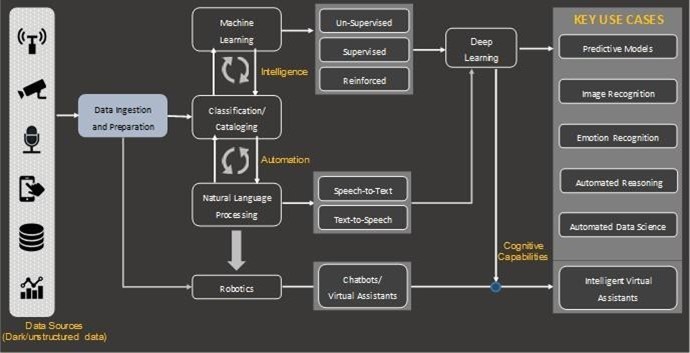
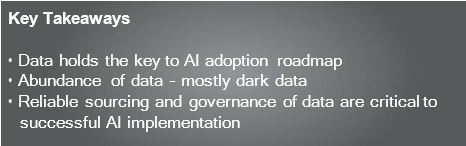
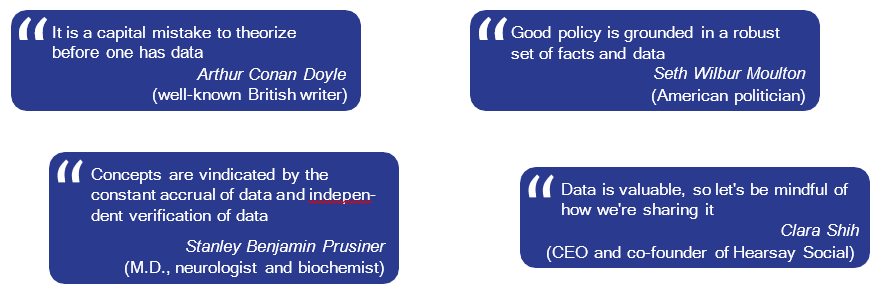
The illustration of the AI framework above, highlights the significance of data ingested into the system for generating reliable and actionable insights. With that said, it can be inferred that data is as important as the algorithms itself and sometimes even more. The machine learning or deep learning algorithms are trained based on several parameters which are data intensive. So, a good training, is invariably dependent on the quality and quantity of data fed, for the process of tuning the system to perform desired functional- ities.
Again, as the current business environment is transient, there is constant accrual of new data that can significantly change the desired purview of a given scenario that is being analysed. So, these changes in data should be carefully ingested and classified which can sometimes generate interesting patterns. These patterns reveal crucial informa- tion that can help organizations to step ahead of their competitors in terms of providing enhanced customer experience.
Now, this brings us to another aspect of data in this modern digital environment, where we have huge amounts of data in various formats, which can be structured, unstructured or semi-structured. However, unfortunately, still about 80% of the data present is in the form of dark data, which is either not being captured or we do not have the tools and/or right skill sets to capture and analyse the same. This presents a huge opportunity for exploring new frontiers with AI with increasing computing capabilities and big data analytics capabilities
Common AI implementation challenges!
The AI evolution concept can be related to the way a child learns. Wrong concepts and misguidance is unfavourable for the child’s future while lack of education or training leads to blissful ignorance! Likewise, the training and/or learning process of the machines should be continuous, with data scientists governing the quality of data being fed.
#1 Now this brings in the questions – do we know what data and quantity of data that needs to be ingested for the training process? Do we have enough data scientists to govern the process?
#2 So then, this brings to our next set of questions who confirms to our understanding of a real-life problem as certain problems are relative to individual perceptions?
#3 Well, this sounds great! However, it brings me back to the first question – do we have enough data to start learning future patterns
#4 AI could disrupt the foundations of the digital transformational journey with unclear future implication.
Healthcare Applications
AI applications in clinical health can raise more than $150 billion annual savings for the US healthcare economy by 2026. AI application has incredible potential in healthcare including diagnostic imaging, anti-fraud, resource and asset optimization, readmission prevention, behavioural analytics, medical risk analytics, claims analytics, and many more. Major opportunities of AI in Healthcare industry are pointed below: