Artificial Intelligence- The New Wave of Digital Transformation
It is certainly not an embellishment to portray Artificial Intelligence (AI) as one of the most promising technology of this digital millennium. AI is capable of assisting in multifari- ous applications from helping doctors in identifying diseases to supporting marketeers in predicting sales across multiple channels.
INTRODUCTION
“It is not the strongest or the most intelligent who will survive but those who can best manage change.” - Charles Darwin
It is certainly not an embellishment to portray Artificial Intelligence (AI) as one of the most promising technology of this digital millennium. AI is capable of assisting in multifari- ous applications from helping doctors in identifying diseases to supporting marketeers in predicting sales across multiple channels.
This remarkable breakthrough is an embodiment of the current scenario of digital transformation, where the transi- tion towards a connected network of entities is translating into an ecosystem that produces massive volumes of information. Organizations can now unravel the rich and abundant information that has so long been obscured in the form of dark and unstructured data. Consequently, endless business opportunities have been unfurled with the rapid enrichment of the computational prowess using big data analytics capabilities. In a short span of time, AI has trans- formed from what seemed to be a distant dream for a handful of interested researchers to a reality, which eloquently surrounds and influences almost every business and end user. As this technology matures further, every business should ask the most pertinent question – “how will AI disrupt the industry?” To analyze and understand this it is necessary to understand the full potential of AI and what it means to businesses in its current state of evolution.
WHAT IS ARTIFICIAL INTELLIGENCE?
AI can be described as a set of algorithms generated through systematic study of neuromorphic systems which can eventually generate pre-emptive rationale based on explicit self-learning proficiencies.
The existing algorithms enable the computing systems to be technically proficient in fabricating desired results using a systematic rule-based approach or fuzzy logic. This method resembles the decision-making capabilities of the humans which basically utilizes multi-tier schematic mapping of critical real-world (business) problems in conjunction to a mapped time series analysis. Consequently, the system’s ability to learn and inculcate human comparable self-proclivity characteristics transcends diligently based on previous events.
Figure 1: Data Ingestion And Applications Of Artificial Intelligence
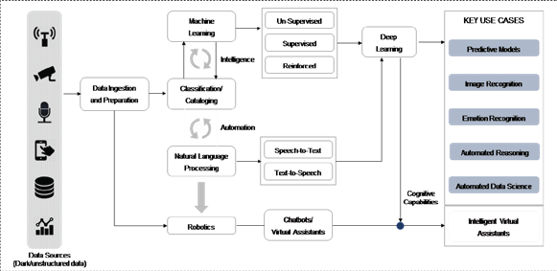
Note: The above figure establishes the flow of data to showcase the various functional applications of artificial intelligence
Source: IHR Insights
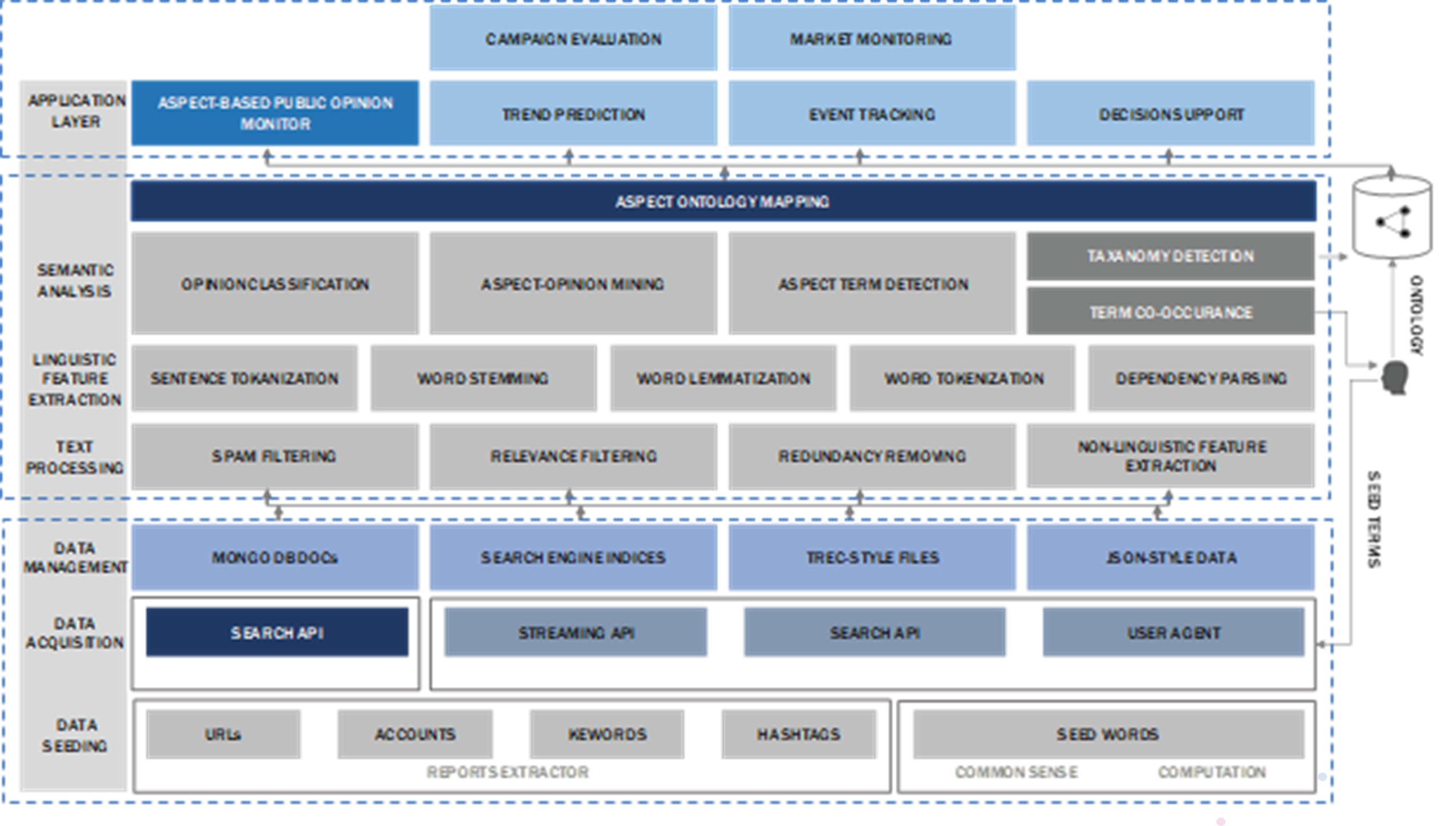
Figure 2: Overview Of The Artificial Intelligence Platform Architecture
Reference: AAAI Conference on Artificial Intelligence, Publication Mc-Gill University, IEEE/WIC/ACM International Confer- ence on Web Intelligence and Intelligent Agent Technology
The figure above depicts three distinct functional layers - data, analysis, and the application layer.
Data layer has been further segregated based on the three major functions – selection of seed words (data seeding), data acquisition, and data management. The seed words are important keywords used for search queries and are usually specific to domain or topic being investigated. The subsequent data acquisition process can be specifically associated to the keywords being used to search historical data from any of the social media or search engine APIs (application programming interfaces). This data acquisition process can also be seeded to ingest streaming data from simulated user-agent that monitor new posts or feeds on social media. Based on the data processing/analysis request, the data collected is subsequently stored and managed using different data management techniques.
For instance, MongoDB is used for real-time I/O operations, while the Trec-style data format is used for generating search indices and adaptive relevance filtering of simulated interactive user feedback searches. data, analysis, and the application layer.
Analysis layer can be categorized majorly into four sequential processes – data preparation/pre-processing (data quality), semantic analysis, taxonomy extraction, and ontology-based hierarchy (aspect) mapping or categorization.
Application layer includes tools for various end-use applications such as predictive tools for market trend prediction and decision support for pre-emptive risk mitigation or even sentiment probabilistic distribution analysis or emotional cues for campaign evaluation on a target audience.
The following sections will broadly touch base on each of the above-mentioned layers in terms of major trends, their significance in the AI transformational roadmap, and the major challenges faced.

EVOLUTION OF ARTIFICIAL INTELLIGENCE
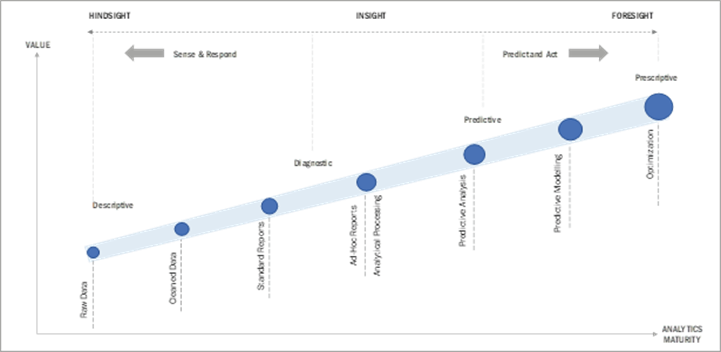
Being a data driven company is the foremost distinctive feature of an organization’s AI journey. The transformation process is initiated with collection of raw data essential for situational awareness. This enables a basic reactive approach based on historical data (raw data) with limited protocols and standards to govern the data sanity. However, as an organization, it is essential to include various best practices to move ahead in its AI transformational path.
So, for an effective build-up of the entire process of this AI driven transformational propaganda, organizations need to be careful about some of the following best practices:
Systematic understanding of data and the sources of data
Systematic schematic planning and analysis of the varied digital strategies that are suitable for the organization
Careful selection of partners in digital journey
Prioritization of processes and digital solutions to be implemented to enable seamless transformation
Organizational readiness assessment and restructuring
Transparent strategy formulation and ethical AI driven DXE implementation
Continuous monitoring and testing
As the AI driven digital roadmap promises limitless possibili- ties for organizations with immediate ROI being realized through its benefits in the field of marketing, it is essential to always align the strategic implementation of customer intelligence with clear set ethical boundaries. There have already been some well-known instances of organizations having crossed the moral obligation that ownership of data presumably infoliates. With this in perspective there are a few set standards and regulations that organizations have to comply, as a part of their best practices –
GDPR (General Data Protection Regulation) – 2018
FISMA (Federal Information Security Management Act) - 2022
HIPAA (Health Insurance Portability and Accountability Act) – 1996
Figure 3: Progressive levels of maturity in analytics subjective to evolution of artificial intelligence
Source: IHR Insights
Progress in Artificial Intelligence
Over the past decade, thousands of cutting-edge applications have been entrenched in the infrastructural set-up of almost every organization across industries. Some of these applications are sometimes no longer labeled or addressed as AI, as some of the AI use-cases being so innate to the daily operations such as the web crawlers and other
AI-based information extraction programs, introduced in late 90s, essentially used for the World Wide Web. Such applications are the foundation blocks to the data discovery process which is essential for the personalized recommendations in the new marketing strategy being deployed by organizations
Inception of AI research started over half a century ago, with the intent of enabling machines to have human like intelligence; and in the pursuit of creating machine intelligence, numerous developments have unfurled especially over the past few years. Today, AI can be broadly categorized into two types –
Narrow artificial intelligence or weak AI: This is focused on creating machines that are able to solve specific problems based on pre-defined programming logic (rule-based). In current AI development phase, the existing AI related products are mostly Narrow AI. For instance, Apple Siri, a personal assistant app or even the IBM’s Watson which was able to beat two champions in Jeopardy, are all Narrow AI. Many of these contemporary AI systems are quite powerful, yet they are mostly specialized in specific tasks and inflexible. Though with embedded machine learning (ML) and natural language processing (NLP) capabilities, some of these application platforms show impressive competencies in outperforming humans, nevertheless the situation in which these systems display certain degree of intelligence is limited to the particular field.
Artificial general intelligence (AGI): This allows machines to perform multifaceted tasks with intelligence comparable to human beings. Basically, this would enable machines to exponentially outpace human capabilities in terms of knowledge, cognitive ability, and speed. So, AGI or truly intelligent AI, personifies at least the following essential abilities –
o Prioritization and situational awareness.
o Automated reinforced and unsupervised learning (self-learning)
o Natural language understanding (NLU) with ability to appropriately decipher syntactical connotations of varied semantics of natural language.
o Superlative abilities in “theory of mind” with short term memory of recent events and the reconciliation of the incidents in context to existing real world problems.
THINGS TO KNOW
Organizational AI Readiness
Assume that all organizations are privileged with equal exposure to a set of extremely efficient and desirable AI platforms, ready to be tailored as per their business requ sites. Now, to understand and analyze an organization’s AI readiness, the following questions need to be taken into considerations –
What are the top 2 priorities that your company has or would it be willing to invest in AI, as a part of its AI based digital transformation initiatives?
Is your organization already using AI driven approach for key business functionalities such as marketing campaigns? If yes, what are the key aspects of this initiative that you believe is making a difference in creating new growth areas for your organization? (choose the relevant options)
o Real-time customer support across multiple channels or touchpoints
o Understanding behavior patterns to personalize and enhance customer experience
o Understanding behavior patterns to identify new customers
o Identify and analyze key customer pain points (from emotional cues) to add new/enhance existing service offerings
o Analyze and score key internal performance metrics
o To manage and optimize internal operations across business functions
On a scale of (1–5, 5 – highest/strongly agree; 1 – lowest/completely disagree; 3 - don’t know/indiffer- ent/not sure) Do you have the right people and skill sets to define the AI roadmap for your organization?
On a scale of (1–5, 5 being highest) How clearly is your AI based digital transformation strategy articulated?
On a scale of (1–5, 5 being highest) How competent is your workforce in understanding the value proposition of AI in context to setting up a seamless integration between the set customer expectations and across the multichannel client facing environments/interfaces?
On a scale of (1–5, 5 being highest) How competent is your organization in measuring and clearly articulating the business results of the existing artificial intelligence marketing strategy?
On a scale of (1–5, 5 – highest/strongly agree; 1 – lowest/completely disagree; 3 – don’t know/indifferent/not sure) How prepared is your organization structure and cultural integrity, in terms of taking a strong transformational step towards creating an agile organizational structure (essential for an effective cross functional collaboration within an AI augmented workflow)?
On a scale of (1–5, 5 being highest) How clearly have you identified the redundant processes for your marketing programs that can be handled by your AI based digital transformation roadmap?
• On a scale of (1–5, 5 – highest/strongly agree; 1 – lowest/completely disagree; 3 – don’t know/indifferent/not sure) Does your company have a dynamic and scalable technology budget for shifting priorities such as moving to agile and scalable cloud-based infrastructure or investing in multichannel digital experience platform to support AI driven digital transformation?
The chart below showcases the AI readiness of organiza- tions globally, based on multiple surveys done across a balanced spread of large MNCs, small & medium enterpris- es, and start-ups. The results clearly show that predomi- nantly most companies (categorized as opportunistic) are well balanced to move to the next stage of AI digital evolu- tion, based on their vision, operations, skill sets, and their existing digital infrastructure. This might happen in the near future or over a period-of-time which will be discussed briefly in the next section. So, each of the categories have their own set of pros and cons in the path of AI driven digital transformation roadmap.
KEY FINDINGS
Improved customer experience and reduction of operating costs (OPEX) stand out as the top incentives for AI driven digital transformation among end users (with almost 50% of the businesses globally conforming specifically to these two factors as a major business driver)
Outdated workflows and traditional infrastructural (legacy technology and application) set-up, along with core functional strategies made in silos are the major roadblocks to seamless AI based digital transformation for almost 40% of the organizations globally.
Readiness based on strategy, operations, and technology acumen
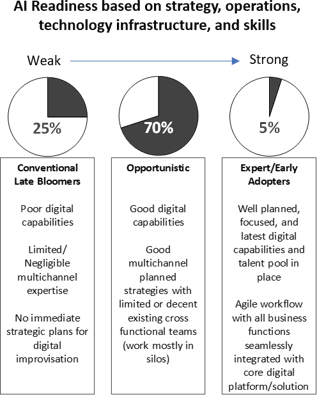
Figure 4: Organization ai-driven digital transformation readiness index
Source: IHR Insights
MARKET OVERVIEW
Key Regional Dynamics
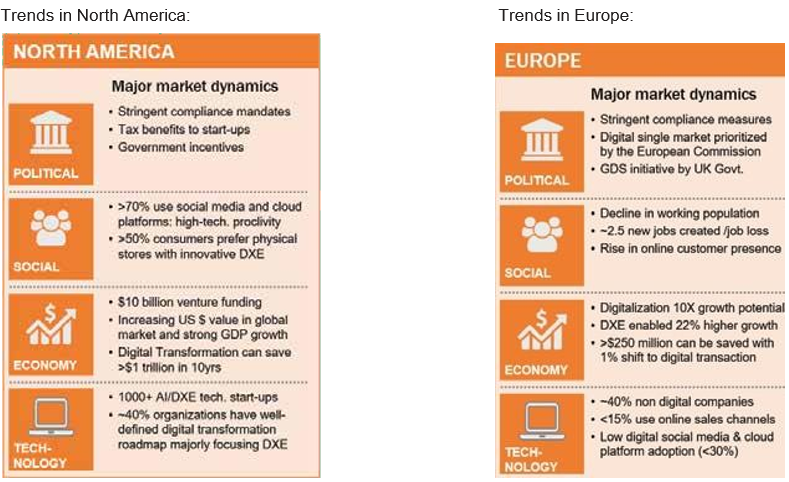
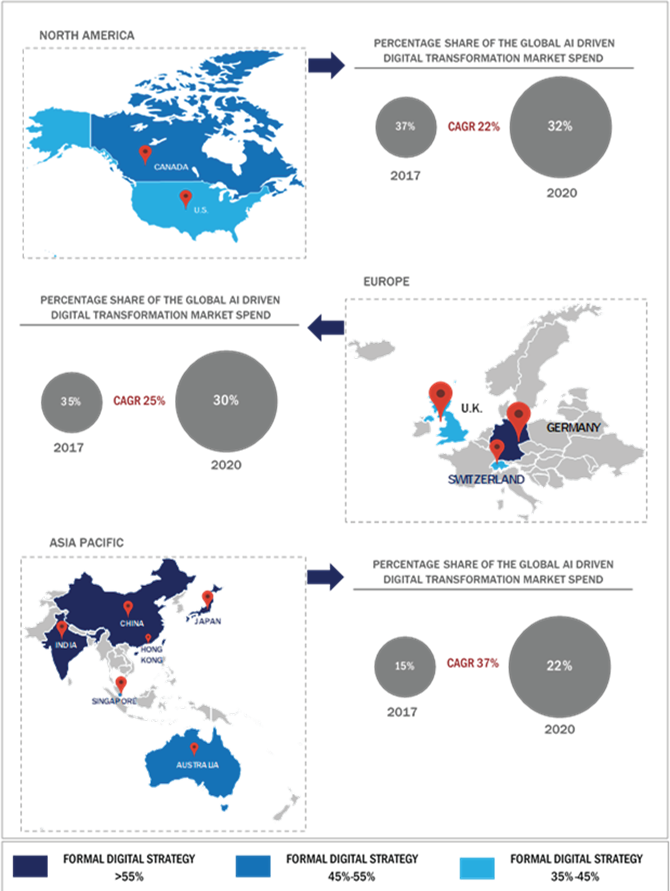
North America demonstrates a substantially higher percentage of CXO’s being involved as leaders in the AI driven digital transformation initiatives as compared to their counterparts in other regions. This directly translates to organizations in the region which showcase a prominently higher propensity to adopt most technology innovations.
However, even with this positive foundation, the region is lagging behind some of the nations across Asia and Europe in terms of formal enterprise digital transformation strategy.
Moreover, even though the region has the highest number of AI technology start-ups, it has not directly translated to formal enterprise implementation across industries, with over 20% organizations still in planning phase, ~25% with digital transformation started in siloes, and over 15% of them, showing no signs of any activity.
Europe has been over indulgent with its privacy regula- tions. Moreover, as consumers in this region after having realized the rich trail of information that they leave behind during their digital experience, have been consciously more vigilant about their online presence and consequently their digital footprint. Consequently, over 35% of the European enterprises cite adherence to regulatory obligations as the highest priority.
As AI driven digital transformation is data intensive, stringent regulations for data privacy poses a huge challenge especially for personalized digital marketing campaigning programs. However, as European organizations constantly indulge in innovative new business revenue streams, way more than their counterparts in other regions, it is expected that once the digital best practices are well organized in line with the regulations such as GDPR norms, the region is set to witness a widespread drive for their “fourth industrial revolution”, with growth potential projected to be 10 times with digitalization.
The key opportunity lies in transformation of the existing industries, especially with the sectors such as automotive manufacturing and tourism related service sectors, which hold a leading position in the global market.
TRENDS - REGION
TRENDS - REGION
Figure 6: Percentage share of the top three ai driven digital transformation spend across industry verticals
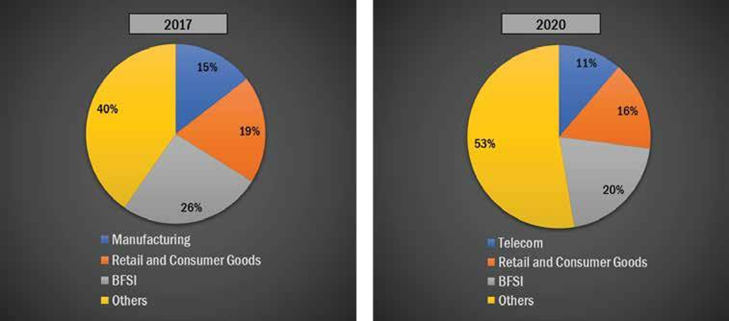
Note: The above market share is a global cumulative analysis and is rounded off to the nearest decimal place
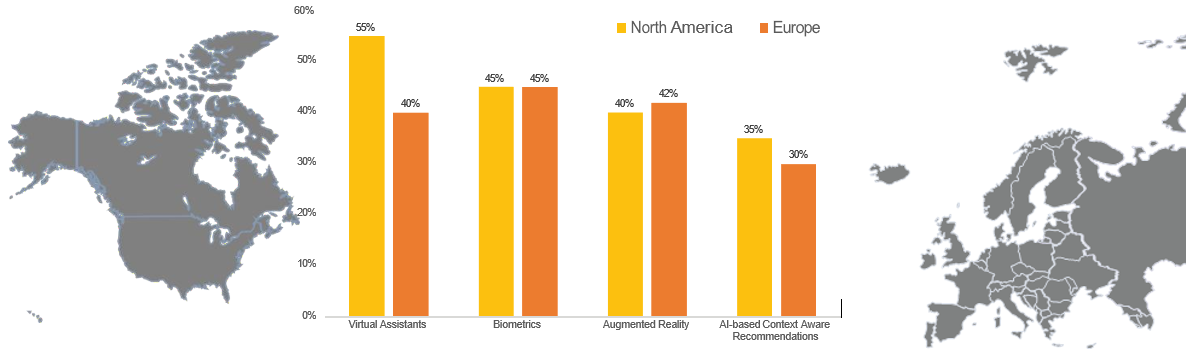
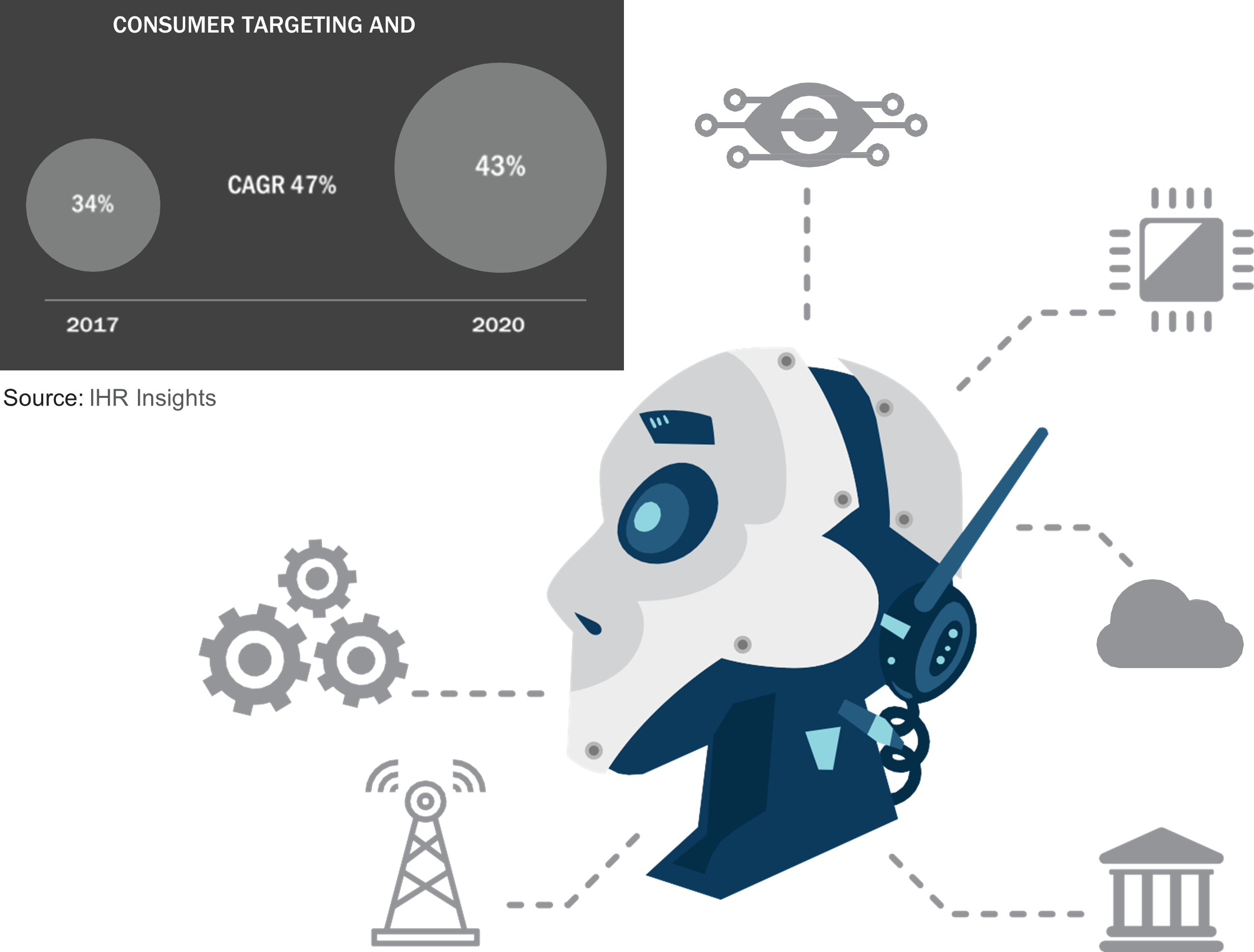
Figure 7: Percentage share of the most trending ai-application by market spend
ARTIFICIAL INTELLIGENCE ROADMAP
Common AI Implementation Challenges! The AI evolution concept can be related to the way a child learns. Wrong concepts and misguidance are unfavorable for the child’s future while lack of education or training leads to blissful ignorance!
Likewise, the training and/or learning process of the machines should be continuous, with data scientists governing the quality of data being fed.
Now this brings in the questions – do we know what data and quantity of data that needs to be ingested for the training process? Do we have enough data scientists to govern the process?
Though repeated experiments are being done to automate this process using neural networks which sounds wonderful, however in theory and in real world application it is extremely complex. The reason being, most theoretical problems take in a lot of estimations and assumptions, which can be easily solved with linear regres- sion analysis. However, most real-life problems are complex and require non-linear regression. These problems mostly incorporate time series analysis and when you need to automate the thinking process with high speed computation, then we need to consider that the AI models should already know the things that we know.
This sound ok, but we need to also realise that the model is limited to the conceptual modeling of our own understanding and thus limited to the extent of how you analyze things (with the benefit limited to only being much faster and possibly more accurate).
Well, this sounds great! However, it brings me back to the first question – do we have enough data to start learning future patterns?
Considering that the business critical functions have been identi- fied, then the processes that have imminent risk of failure, need to be worked upon. For this to be achieved, we can leverage AI driven automation and set up bots which can crawl across numerous functional paths of an organization’s digital footprint to highlight mission-critical functions and thereby enable similar incidents to be uncovered which percolates to pattern identification for predicting future anomalies/variance from existing rules.
AI could disrupt the foundations of the digital transforma- tional journey with unclear future implication.
Most transformational journeys, the classic example being the introduc- tion of computers, have created an uproar of impeding employment for masses. However, most technologies have evolved in creating more opportunities along its way of evolution. Similarly, AI could potentially be a boon for mankind in its path of evolution or on the contrary – as predicted by Stephen Hawking: “replace humans altogether”. Now, that statement as of now, may seem outrageous but do we know for sure? So, the most apt and challenging question for AI in current scenario is best described by the following quote –
I don’t need to know every- thing, I need to know where to find it, when I need it. - Albert Einstein
So then, this brings to our next set of questions – who conforms to our understanding of a real-life problem as certain problems are relative to individual perceptions?
Now, supposedly if we align our understanding and design our AI strategy for a given set of prob- lems, the above concern could be resolved. However, as we know that most pertinent problems statements and the real-world scenarios for a competitive business environment are transient. Often by the time the problems are resolved, we are intrigued by a new set of mind-boggling mysteries to unravel. Now, AI experts have a solution to this problem, where each new instance of problem can be ingested as a new incident in the time series. Moreover, each similar incident can be categorized with well-defined tags that enable the algorithms to build patterns over a course of period.
CASE STUDIES:
Considering use cases from top two leading industry verticals in terms of market spend for AI applications
CASE #1: Banking, Financial Services, and Insurance JPMorgan Chase: (An American multinational investment bank and financial services company – among top 10 largest financial institutions in the world in terms of revenue and market capitalization) $9.5 billion allocation of funds (planned budget) for technology investments.
2015: Launched machine learning driven Emerging Opportunities Engine used as a predictive recommenda- tion to “identify clients best suited for follow-up on equity offering” and post its success, planned expansions were introduced for other application areas (such as debt capital markets) based on predictions of client financial data, issuance history and market activity.
2016: Established a center of excellence (within its Intelligent Solutions group which drives innovation across the firm by leveraging big data and advanced analytics such as machine learning)
2016: Contract Intelligence (COiN) platform rolled out as a pilot project. The platform uses machine learning to review thousands of legal documents and deliver proper interpretation of the clauses and critical data points gathered from it.
2017: Planned roll-out of its virtual assistant technology, termed as “cognitive automation” which is powered by natural language processing interface, to help in assistance in applications such as service tickets and thereby automate about 1.7 million requests annually. This was set with targets of at least $1.3 million in savings annually.
Future (2018 and beyond): Plans on increasing use cases of machine learning to applications such as anomaly detection for fraud and cyber threat prevention, thereby creating a secured and optimized roadmap for targeted-trading strategies and client servicing channels.
Conclusion: JP Morgan is shifting towards an enhanced customer targeting and engagement strategy, by applying an AI-powered digital transformation roadmap.
CASE #2: Retail and Consumer Goods (CPG)
Walmart: (An American multinational retail corporation and one of the largest physical retail chains across the world)
2017: Pilot run of “Shelf-Scanning Robots” capable of monitoring aisles for pricing issues, misplaced items, and assess stock levels. These robots use 3D imaging to roam around the aisles and dodge obstacles in its pathway.
Conclusion: This concept is being extended to 50 stores after its successful pilot project. This initiative is eventually intended to assist Walmart in its online customer engagement, with real-time updates of pricing, offers, and stock availability. The company has promising growth prospects through this initiative with a projected 50% more productivity and three times faster turnaround than humans.
Other Use Cases:
Manufacturing: Toray Plastics Inc. was looking for solutions that provided optimal data-driven
decision making capabilities for optimized manufacturing operational performance. The company accomplished it by partnering with General Electric (GE) and AutomaTech (a GE partner).
Telecom: AT&T incorporated AI to process all “online chat interactions” at the customer service level and in 2016, AT&T rolled out “Atticus”, the entertainment chatbot that operates through the Facebook Messenger platform after expanding its AI capabilities to its entertainment sector.