Legitimizing Talent for RPA
As enterprises move ahead with automation efforts, the degree of success and Return on Investment (ROI) is heavily reliant on technology and process. In reality, these initiatives take a backseat when key parameters including people, process and technology are not met for successful project implementation and especially when due consideration is not emphasized on the people factor. The golden triangle, either forgotten or often misinterpreted by enterprises includes the key factor – “People”.

Legitimizing Talent – The way forward for RPA
“People” – The missing link
As enterprises move ahead with automation efforts, the degree of success and Return on Investment (ROI) is heavily reliant on technology and process. In reality, these initiatives take a backseat when key parameters including people, process and technology are not met for successful project implementation and especially when due consideration is not emphasized on the people factor. The golden triangle, either forgotten or often misinterpreted by enterprises includes the key factor – “People”. Without due consideration to the human element to implement the RPA projects, enterprises have embarked on their process automation journey and hence the resultant crisis of a global lack of skilled resources to develop as well as implement RPA technology. Most enter- prises approve the capability of RPA technology to gain productivity with minimal workforce but struggle with their RPA projects due to unavailability of resources with desired expertise in the market. Currently, many financial service organizations are evaluating and adopting RPA, with heavy impetus on the technology to carry out repetitive tasks. The key strategy while opting for a specific RPA technology or vendor, is to select the functions or processes in an organiza- tion’s system which require automation as well as decide on the portions that require exception handling. Enterprises need to choose the apt RPA vendor, assess immediate risks associated in automation of those selected processes while evaluating and implementing system upgradations within a short span of time. The absence of adequate skilled resourc- es in the job market is prevalent across vendors, system integrators, consultants, as well as enterprises and end-user clients at large. The skill shortage has become a big restraint to the growth of RPA market.
Chart 1: Evaluation cycle for RPA adoption
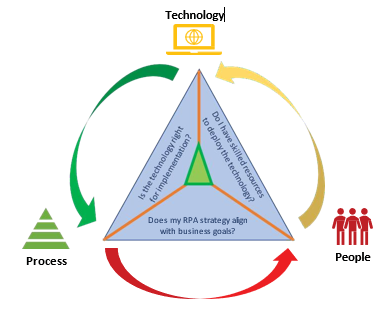
The golden triangle, either forgotten or often misinterpreted includes the key factor” - People
RPA ecosystem
The stakeholders of the entire RPA ecosystem are struggling to keep pace with the demand for skilled resources in development, integration, consulting, support, and deployment functions. While the technology and processes are matured with several use cases and project deliveries, the extensive experience of most RPA resources are limited only to OCR and process mining. The present level of experienced resources in RPA are skilled in rule-based programming or development and are gradually moving towards NLP, ML, analytics, consequently leading to cognitive RPA development. Most organizations are focused on filling the open positions in RPA, irrespective of scrutinizing the expected functional and technical capabilities that match perfectly with the desired role. Recruitments in the RPA space have become complex as it is extremely difficult to find the right resource with 3 or more years of experience in the current market. In most cases, their pay scale is either excessively high or they are unwilling to change their employer in order to enhance their skill-set in their current projects.
“ The present level of experienced resources in RPA are skilled in rule-based programming or development”
Chart 2: Skill shortage across the journey of RPA adoption
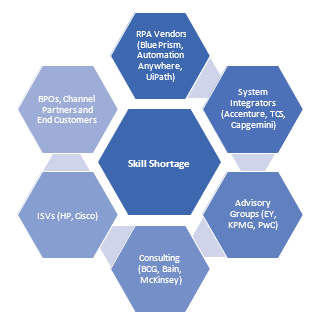
RPA recruitments: Key considerations
Based on our research, 9 out of 10 enterprises in North America and Western Europe are expected to start their RPA journey by 2020 and standardize the platforms as well as strategies to bring forth the ROI for enterprises. The top RPA vendors are already focusing on training and education, and enrolling university graduates to get RPA certified from online classes, virtual training and documentations to get certifications in RPA for different roles - developers, functional consultants, architects, and others. Many organizations have also established their COEs for governance, well established roles and responsibilities, management, and collaboration. The biggest constraint among all these strategies for successful implementation is the dearth of skilled resources for each of those roles. Thus, traditional recruitment models of job boards or LinkedIn may direct the employers to find resources in RPA to fill the positions for RPA projects. In this situation, RPATalent.com is aptly positioned to deliver right RPA professionals, according to relevant job roles and platforms.
RPATalent.com – More than bridging talent and requirement
“The legitimization is one feature that makes it stand-out and distinguished in the recruitment model. ”
On the surface, RPATalent.com comes across as a recruitment tool to bridge the gap between resources and enterprises directly, however, it acts as a platform to legitimize resources present in the database of RPATalent.com. It also has strategic partnership with Edge Tech, a recruitment firm with presence in the UK and US, specializing in recruitments of professionals in digital technologies such as RPA, IoT, AI, Machine Learning, Data Science, and Blockchain. RPATalent.com has also been actively associated with RPA Academy, a training partner of the top 3 global RPA brands, namely Blue Prism, Automation Anywhere, and UiPath. RPA Academy also plans to add more RPA platform technologies and train professionals to deliver the high demand for different RPA skilled resources. Thus, RPATalent.com provides its assistance to both, employers and employees, measuring the skill set requirements.
The legitimization is one feature that makes it stand-out and distinguished in the recruitment model. Recruiters and managers devote ample time in searching, interviewing and onboarding a new hire in an organization. RPATalent.com directly showcases candidates rated by their previous employers, thus legitimizing their talent in the dashboard of RPATalent.com. The rating feature approves resource’s talent, credibility, and performance in carrying out RPA projects. For job seekers, the platform offers a conversational tool as well to discuss projects directly with the employer. Thus, employers and employees can simultaneously assess the project details at their end for open job position
requirements and identify skill-set possessed by the candidate in their previous assignments. This enhanced feature in the platform is expected to create better opportunities for experienced professionals and help enterprises in quick on-boarding of skilled resources.

THE ROAD AHEAD
The resource database allows employers to funnel resources as per the different criteria - technology, industry, accreditations, language and location. The recruitment portal acts as a seamless platform where the employer and the employee can easily find the best talent match for an enterprise. Currently, only three brands, Blue Prism, Automation Anywhere, and UiPath tops the list while searching for resources, but over a period of time, resources with knowledge of other software vendors such as Softomotive, Pegasystems, Kryon and others are expected to create a larger pool of talents across the globe. The RPA technologies offered by different vendors works differently and may have an entirely different software architecture. For instance, Blue Prism and UiPath have distinct differences in its foundations and functionalities and thus the resources skilled in these two technologies would differ from each other. Blue Prism offers a distinctive feature of scalability that meets the criteria of large enterprises to handle multiple applications simultaneously. Blue Prism runs on Microsoft.Net and each bot works in its individual virtual machine (VM). Each of the skilled resource pool offers various RPA stakeholders to get more insights on the resource’s earlier RPA engagement or project in different technologies and platforms.
Given RPATalent’s legitimization approach for everyone, the platform will become a source of measuring talent pool in RPA space, estimate market penetration of RPA vendor’s technology among professionals and estimate their pros- pects. Resources signing up on the platform can indicate the shift in RPA market to those vendors with the largest available talent and hence will measure their course of action for market growth.
Training institutes and skill upgradations of resources among enterprises or IT vendors are playing an active role to bridge the skill gap in the RPA space. RPATalent.com is all set to disrupt the traditional recruitment process in hiring skilled resources for three different type of players such as product developers, service providers and clients. Relying on a collective approach, RPATalent.com is leveraging its strategic partnerships with Edge Tech and RPA Academy to build a database of RPA professionals, ranging from beginners to experienced ones through recruitment firms and enlisting trained professionals specializing in RPA technologies. The recruitment platform thus empowers professionals to join a connected RPA platform, as well as help enterprises connect with right professionals based on ratings obtained from their supervisors or managers to make it a big RPA community. This unique approach makes RPATalent.com a unified platform for RPA technology professionals. It will help enterprises find genuine talent with a hassle-free recruitment processes across any emerging technology. Furthermore, RPATalent.com is all poised to deliver advanced technology professionals in an environment facing a talent crisis.

About Us:
IHR Insights is an independent research and advisory firm delivering market intelligence, custom research, and go-to-market consulting across ICT/Cloud, Data & AI, Security/Telecom, GCC and Healthcare. We serve CXOs, product leaders, GTM teams, and growth-stage businesses—particularly in India, Middle East, and APAC—that demand applied, actionable, and agile Insights. We differentiate through speed (projects in days, not months), productized offerings (syndicated subscriptions, membership tiers, research-as-a-service), a strong peer community (invite-only CXO councils), and proprietary dashboards (live trackers on tech spend, AI adoption, and security posture).
Core capabilities: Market sizing & forecasting, competitive analysis, vendor selection & independent vendor assessments, white-label content creation, analyst-on-demand, and research training (IHR Academy).